
Stabilize Cash Flows and Safeguard Portfolio Performance

Quantify exposure, assess curve scenarios, and design targeted hedging strategies that strengthen corporate balance sheets and stabilize fund returns.

What We Help You Solve

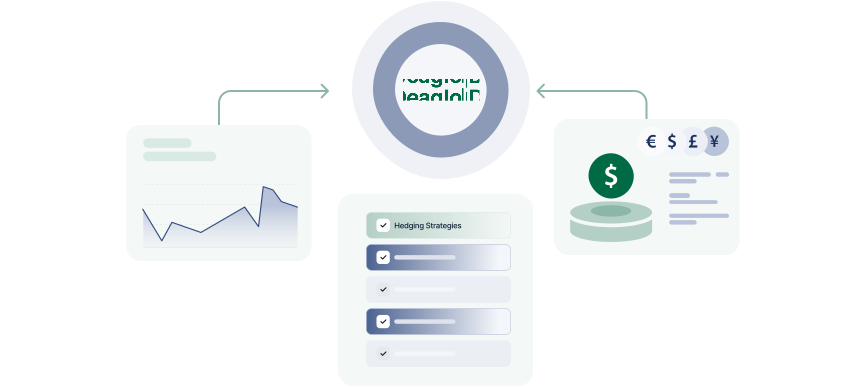
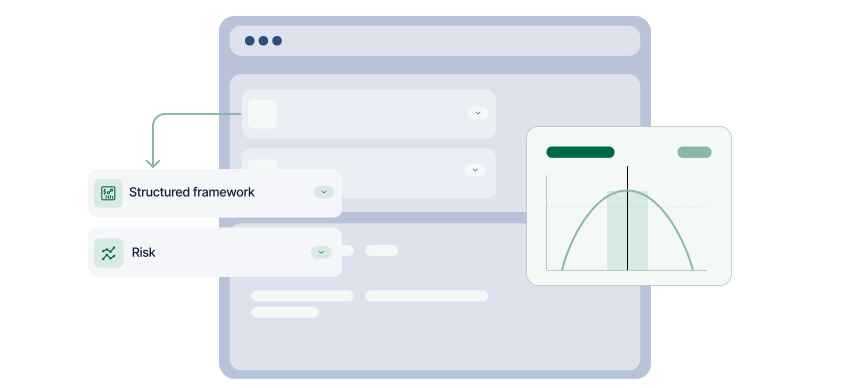
We unify fragmented exposures, quantify risk with clear metrics, and align hedging decisions to a portfolio-level framework.

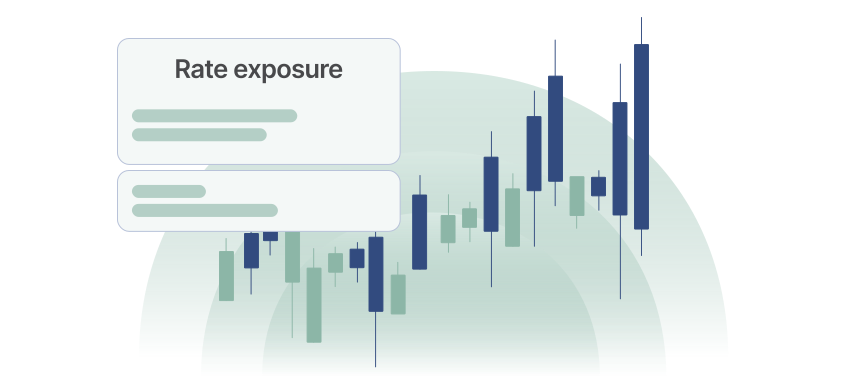
Unclear rate exposure

Fragmented debt across facilities, currencies, benchmarks and reset dates.

No quantified view of risk

Decisions made without clear numbers around CFaR, DV01, IRR, or P&L impact.

Ad-hoc hedging

Swaps, caps and collars put on in isolation, without a portfolio-level view.

Weak board-level narrative

Limited ability to explain “how much risk we’re taking” and “what we’re doing about it.”

Interest Rate Risk Management Built for Corporates

Rate volatility directly impacts portfolio yield, borrower health, and mark-to-market valuations. Floating-rate portfolios benefit from higher income - but also carry higher default correlation. Fixed-rate assets lose value as yields rise. Funds need a disciplined framework to balance income, duration, and downside protection.

Translate rate exposure into measurable financial impact.

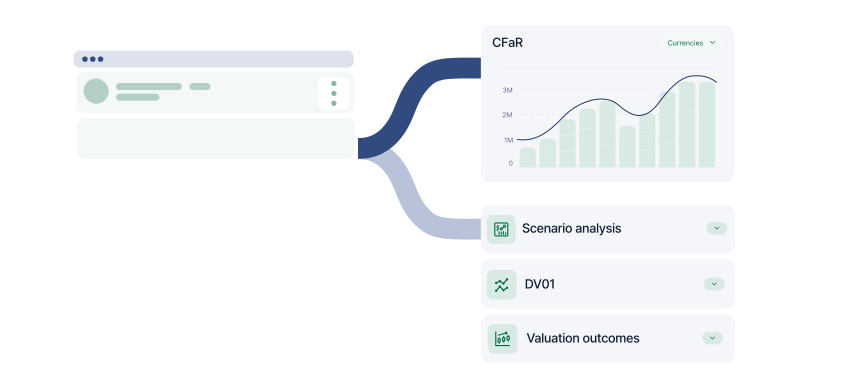
  • Cashflow-at-Risk (CFaR) to quantify volatility in interest expense
  • Duration and DV01 to measure sensitivity to curve movements
  • Scenario analysis across base, stressed, and forward-rate environments
  • Direct linkage to P&L, cash flow, and valuation outcomes
Align rate risk decisions with liquidity and covenant constraints.

  • Clear thresholds for acceptable earnings and cashflow volatility
  • Alignment with liquidity buffers, leverage ratios, and covenant limits
  • Frameworks that support treasury, finance, and executive alignment
  • Documented risk parameters to support governance and audits
Stabilize funding costs with purpose-built strategies.

  • Structured use of swaps, caps, and collars based on portfolio needs
  • Hedging decisions informed by quantified risk and defined appetite
  • Avoidance of isolated, transaction-driven hedges
  • Ongoing evaluation of hedge effectiveness as markets evolve
Turn analytics into confident, defensible decisions.

  • Clear narratives explaining risk levels and mitigation strategies
  • Visual, executive-level reporting aligned with board expectations
  • Transparent rationale behind hedging actions and outcomes
  • Strong documentation to support oversight, governance, and accountability
Tax Compliance & Filings

Preparation of income tax and related filings and tax planning support; compliance with federal, state, and local regulations.*Works with preferred advisors in local jurisdictions.

Interest Rate Risk Management Built for Funds

Rate volatility directly impacts portfolio yield, borrower health, and mark-to-market valuations. Floating-rate portfolios benefit from higher income - but also carry higher default correlation. Fixed-rate assets lose value as yields rise. Funds need a disciplined framework to balance income, duration, and downside protection.

See your full interest rate exposure in one place.

  • Consolidated view across floating and fixed-rate assets at the deal, vehicle, and portfolio level
  • Coverage across benchmarks, currencies, tenors, and reset profiles
  • Clear mapping of rate sensitivity by strategy, fund, and underlying asset
  • Ongoing visibility as portfolios evolve and rate environments change

Translate rate exposure into measurable investment impact.

  • DV01 and duration to quantify sensitivity to curve movements
  • IRR and present value impact under parallel and non-parallel curve shifts
  • Scenario and curve-shock analysis across base, stressed, and forward environments
  • Direct linkage between rate movements, income, valuations, and fund performance

Align rate risk decisions with mandate, liquidity, and return objectives.

  • Clear thresholds for acceptable volatility in income, NAV, and IRR
  • Alignment with fund mandate, liquidity profile, and target return parameters
  • Structured frameworks to support IC, risk, and portfolio-management alignment
  • Documented risk limits to support governance and LP oversight

Stabilize income and manage volatility with purpose-built overlays.

  • Structured use of swaps, caps, and collars applied at the portfolio level
  • Hedging decisions driven by quantified risk and defined risk appetite
  • Reduction of mark-to-market volatility and income dispersion
  • Ongoing assessment of hedge effectiveness as market conditions evolve

Turn analytics into confident, defensible investment decisions.

  • Clear narratives explaining risk levels and mitigation strategies
  • Institutional reporting designed for ICs, LPs, and risk committees
  • Transparent documentation of assumptions, scenarios, and decisions
  • Consistent audit-ready materials supporting governance and accountability

Our Interest Rate Risk Framework

Person in a suit pointing at a laptop screen displaying a cash flow forecast chart during a business meeting.
Two people working at a desk with charts and a laptop, one holding a pen and pointing at documents.
Person pointing at laptop screen with pen during a business meeting around a table with charts, glasses, and a tablet.Three checkboxes labeled: Better execution, Access to liquidity and credit facilities, Multi-dealer pricing.
Person working on a laptop displaying a financial chart with spot history and multiple path simulations, while another person gestures in discussion.
Person in a suit pointing with a pen at a laptop screen displaying a cash flow forecast chart.

Identify Exposure

Understand the full picture before acting.

  • Map all floating and fixed-rate positions: term loans, revolvers, facilities, structured notes
  • Classify by benchmark (SOFR, SONIA, ESTR, SAIBOR), tenor, currency, and reset frequency
  • Distinguish borrower vs. lender exposures and apply the right metrics
Two people collaborating at a desk with charts, a laptop, and holding pens during a discussion.

Quantify Risk

Measure the impact of rate moves with institutional-grade analytics.

  • Scenario and shock analysis on core curves
  • CFaR to understand cash-flow volatility
  • DV01 and duration to measure rate sensitivity
  • IRR and PV impact for each deal or portfolio
  • CVaR to quantify tail-risk under stressed environments
Two people reviewing financial charts and data on a laptop, tablet, and printed papers on a wooden desk.

Define Risk Appetite

Set parameters that align with liquidity, covenants, and performance objectives.

  • Establish thresholds such as max CFaR, DV01 limits, DSCR buffers
  • Translate qualitative views into clear limits and triggers
  • Provide a consistent framework for management and board oversight
Two people standing by a wooden table with a laptop showing data charts, documents with graphs, a tablet, glasses, and a notebook.

Hedge Strategy & Implementation

Execute strategies that stabilize funding costs and protect returns.

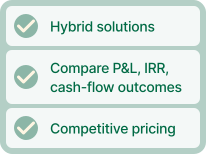
  • Structure swaps, caps, floors, collars, and hybrid solutions
  • Run simulations to compare P&L, IRR, and cash-flow outcomes across rate paths
  • Support execution and negotiate competitive pricing with approved counterparties

Technology That Strengthens the Framework

Advisory defines the strategy - technology ensures precision and repeatability.

Centralized data

Centralized data for debt, derivatives, and curve sets

Automated engines

Automated scenario engines for parallel and non-parallel curve shocks

Real-time tracking

Dashboards tracking CFaR, DV01, duration, IRR, and thresholds in real time

Reporting

Board-ready reporting that turns complex analytics into clear recommendations

Value at Risk (VaR)

Measure potential losses under normal market conditions.

Expected Shortfall

Assess tail-risk beyond VaR to understand extreme scenarios.

Hedge Ratio

Evaluate the optimal alignment between exposures and hedges.

Hedging Costs

Monitor total program costs with real-time clarity.

The Deaglo Advantage

Talk to an Advisor

Institutional-grade analytics

Frameworks grounded in market practice, not textbook theory

Independent perspective

We are not a bank selling derivatives; we advise on what is right for you

Board-level communication

Clear narratives supported by hard numbers

Integrated advisory and technology

Strategy, execution support, and ongoing monitoring in one place

Your Partners in Risk & Returns

Deaglo partners with leading private equity, private credit, real estate, infrastructure, and venture funds to design, execute, and monitor disciplined FX risk programs delivering institutional-grade control, reduced volatility, and stronger investor confidence.

Matheus Zani's linked in photo
Matheus Zani
Managing Director | Head of Risk Management
Victoria Carbone's linked in photo
Victoria Carbone
Senior Fund Specialist | Risk Management
César Cote's linked in photo
César Cote
Senior Associate | Risk Management
Vinícius Rossini's linked in photo
Vinícius Rossini
Associate | Risk Management
Jonathan Harvey's linked in photo
Jonathan Harvey
Managing Director | Risk Management

Your Partners in Risk & Returns

Deaglo’s hybrid advisory + technology model delivers clarity, confidence, and control across every dimension of treasury and accounting.

Frequently Asked Questions

  • What is Deaglo Technologies and how does it help manage FX risk?

    Deaglo is an AI powered financial technology platform that specializes in foreign exchange (FX) risk management. It helps companies and investors understand, model, and mitigate the risks associated with currency volatility. Deaglo’s platform offers strategy performance simulations, hedging strategy optimization, and risk exposure tracking to support better decision-making around cross-border capital flows and transactions.

  • Who is Deaglo designed for—corporates, funds, or financial institutions?

    Deaglo’s platform is primarily designed for FX dealers, business development teams and risk management consultants working at Financial Institutions such as banks and MSBs who cater to the following clients:

    • Corporates with international revenues and expenses, supply chains, or operations that are exposed to FX risk.
    • Investment funds, such as private equity or venture capital firms, managing cross-border portfolios or are raising capital in foreign jurisdictions

    However, there are many tools to which funds and corporates can benefit from on the platform such as Strategy Simulator and Client Portal to manage their cash flows and trades.

  • Is Deaglo a trading platform or a decision support tool?

    Deaglo functions primarily as a decision support tool, not a trading platform such that execution of FX trades must still happen through a separate broker or bank. In essence, the platform helps users understand their FX risk exposures, simulate different hedge strategies, and collaborate with treasury teams to design risk management plans.

  • What makes Deaglo different from FX consultants or banks?

    Deaglo stands apart from traditional FX consultants and banks by offering a technology-first, transparent approach to FX risk management. While banks may offer FX products and limited advisory services, their recommendations often align with internal incentives and can lack impartiality. FX consultants, on the other hand, may rely on manual processes and lack real-time analytical capabilities.

    Deaglo bridges this gap by digitizing FX strategy modeling and providing independent, data-driven insights. The platform uses advanced analytics and scenario simulations to assess risk and recommend optimal strategies, eliminating guesswork and minimizing bias. Clients retain full control over execution and are empowered with tools that promote autonomy and clarity in their risk management decisions.

  • Can I integrate Deaglo with my existing systems or ERPs?

    Yes, Deaglo is built with integration flexibility in mind, making it easy to connect with clients’ existing infrastructure. Whether your organization uses ERP systems like SAP, Oracle, or NetSuite, or relies on treasury or accounting platforms, Deaglo can ingest data from these systems to generate a holistic view of FX exposures. This allows for automation of data workflows, real-time exposure analysis, and synchronized reporting across teams. Such integration ensures that decisions are based on the most current and accurate financial data, reducing the risk of errors and enhancing operational efficiency.

  • What pricing plans does Deaglo offer?

    While Deaglo’s pricing details are not publicly listed, its offerings are typically structured around a subscription-based model, with options tailored to the size and complexity of each client’s needs. Pricing may vary depending on the number of users, depth of features (such as real-time simulations, reporting, and API access), and whether the organization requires enterprise-level integration or support. In general, prospective clients can expect flexible pricing tiers designed to scale with usage—from small corporate treasury teams to large investment firms. For an accurate quote, it’s best to engage directly with Deaglo’s sales or customer success team.

  • Does Deaglo offer APIs for custom integration?

    Yes, Deaglo provides API access to support custom integrations and facilitate seamless connectivity with external systems. This allows organizations to automate data flows between Deaglo and their internal platforms, such as CRM, ERP, or treasury management systems. With APIs, users can pull exposure data, send hedge strategy results to dashboards, or embed risk metrics into proprietary financial models. This capability is especially valuable for firms looking to streamline operations, enhance data consistency, and customize workflows without relying on manual exports or duplicate entry.

  • How do I get started with Deaglo? Is there a free trial or demo?

    Getting started with Deaglo is straightforward. Interested users can request a product demo directly through the company’s website or by contacting the sales team. These demos are typically personalized based on the client’s industry and FX risk profile, ensuring that the walkthrough highlights features most relevant to the organization’s needs. In many cases, Deaglo also offers pilot programs or limited-time free trials to allow teams to explore the platform’s capabilities before making a commitment. During onboarding, clients receive support in setting up their risk models, connecting systems, and interpreting initial results, ensuring they derive value from day one.

  • How does Deaglo use AI and Machine Learning in FX risk management?

    Deaglo’s platform incorporates AI and machine learning into various platform tools such as:

    • FX Assistant: AI is used within Deaglo’s sales enablement reports housed within the FX Assistant by creating explanatory summaries with end clients in mind. Specifically, users on the platform benefit from Large Language Models (LLMs) in the Currency Snapshot and FX Hedging report which provide commentary on spot rate movements, how volatility affects client exposures, the nuances of VaR, and how hedging strategies can provide certainty in the face of market turmoil.
    • Client Portal: AI is used within Deaglo Client Portal by providing the account manager with insights on clients portfolios such as MTM, adverse spot movements, expiring trades, and the necessary next step to effectively managing a hedge program.
    • Strategy Optimizer: Machine learning is used within the Strategy Optimizer to intelligently search and optimize across a wide set of hedging parameters in structured FX products. Rather than relying on manual tuning or random experimentation, the optimizer leverages simulation data and loss functions to evaluate performance, while balancing risk and return.
      • A two-step approach is applied:
        • Step 1: Random Forest (an ML algorithm) is used to help identify the regions of the parameter space adherent to the constraints provided.
        • Step 2: Stochastic gradient descent is used to fine-tune for optimal results, within the constraints.
  • How secure is my data on Deaglo’s platform?

    Security is a core pillar of Deaglo’s platform and a key part of our value proposition, especially for financial institutions and enterprise clients. We follow best in class data privacy and data minimization, and have the highest bar for privacy and security requirements