Challenges in Managing FX Exposure
Foreign currency exposure is one of the most critical yet often underestimated risks in global finance. As businesses and investment funds expand across borders, fluctuations in exchange rates can significantly impact revenues, costs, valuations, and investment returns. Understanding foreign currency exposure is no longer optional, it is essential for CFOs, treasury teams, and investment managers making cross-border financial decisions.
.png)
Why Foreign Currency Exposure Matters
Currency movements can directly influence:
- Revenue volatility (e.g., USD strengthening reduces overseas earnings)
- Profit margins (import/export cost fluctuations)
- Investment returns (IRR impact for funds)
- Balance sheet valuations
- Debt servicing costs in foreign currencies
For funds and corporates operating globally, unmanaged FX exposure can erode returns—even when the underlying business performs well.
Types of Foreign Currency Exposure
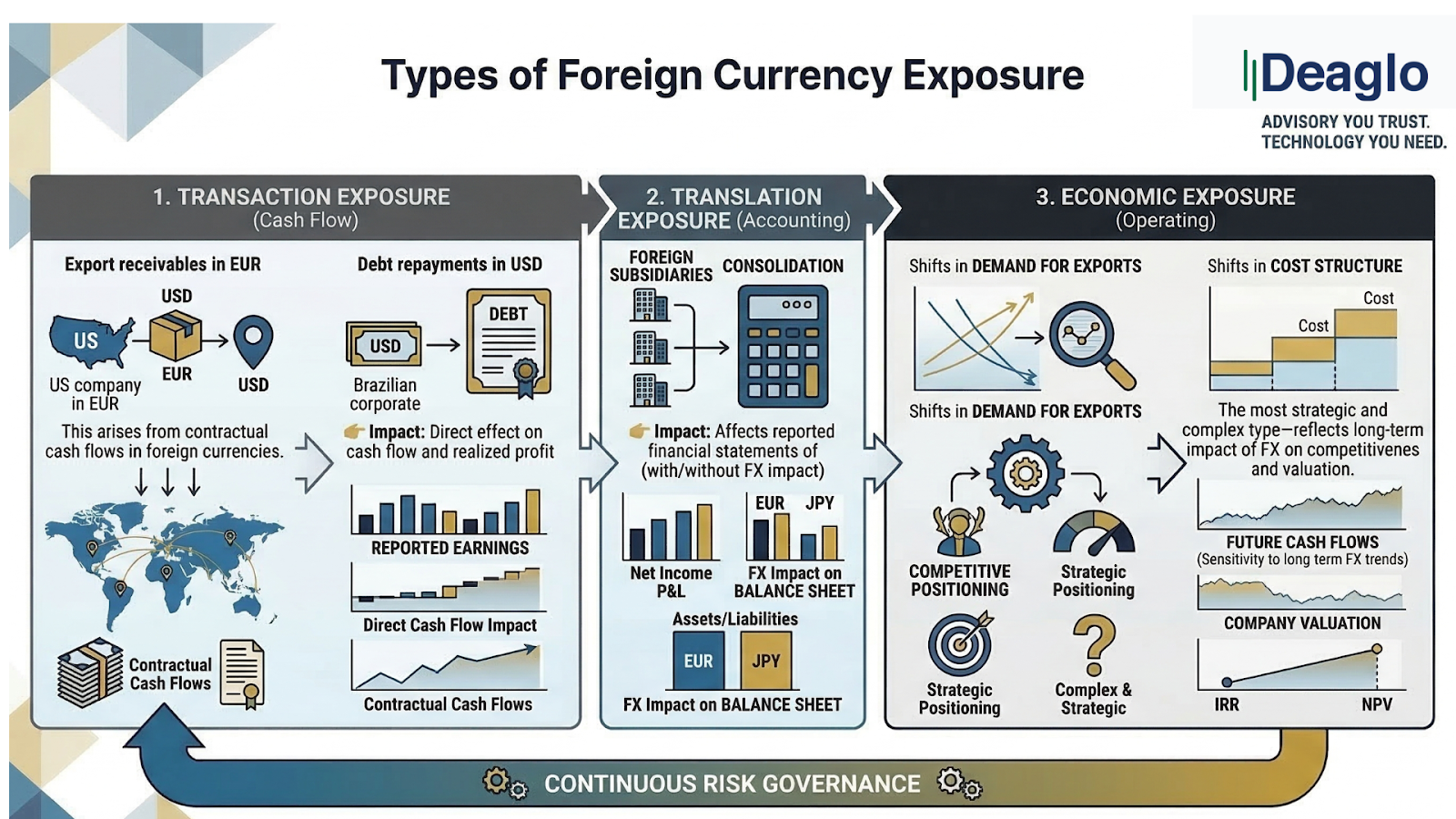
FX exposure can be categorized into three core types—each impacting financial performance differently across time horizons.
Transaction exposure relates to contractual cash flows in foreign currencies and has a direct impact on realized cash flow and profitability.
Translation exposure arises from converting foreign subsidiary financials into a reporting currency, affecting reported earnings but not immediate cash flow.
Economic exposure reflects the long-term impact of exchange rate movements on competitiveness, future cash flows, and overall valuation.
Together, these three types of FX exposure form the foundation of effective FX risk management, helping corporates and investment funds understand where currency risk originates and how it impacts financial outcomes.
Examples of Foreign Currency Exposure
Understanding FX exposure is best illustrated through real-world corporate and investment scenarios.
Corporate FX Exposure Example
A US-based company sells goods in Europe, generating revenue in EUR while maintaining costs in USD. This creates a direct FX exposure (foreign currency exposure) between EUR and USD.
.png)
Impact of FX Exposure
- Revenue declines by $1 million due to exchange rate movement
- Operating profit decreases by $1 million
- Margins compress from 27% to 20% despite unchanged sales volume
FX exposure directly reduces cash flow and profitability, increasing earnings volatility even when underlying business performance remains stable.
.png)
Investment Fund FX Exposure Example
A private equity fund invests in a Brazilian asset, where returns are generated in BRL while performance is reported in USD. This creates FX exposure between BRL and USD.
.png)
Impact of FX Exposure
- $20 million gain is eliminated due to currency depreciation
- IRR drops from ~20% to ~0%
- Fund performance appears flat, despite strong local asset growth
This occurs even though:
- The asset increased in value from BRL 500M → BRL 600M (+20%)
- Operational performance remains strong in local currency
FX exposure reduces realized investment returns and distorts performance metrics, affecting investor perception and reported fund performance.
How to Measure Foreign Currency Exposure
Measuring FX exposure (foreign currency exposure) is a critical step in effective FX risk management. Organizations must quantify how exchange rate movements impact their cash flows, assets, liabilities, and overall financial performance.
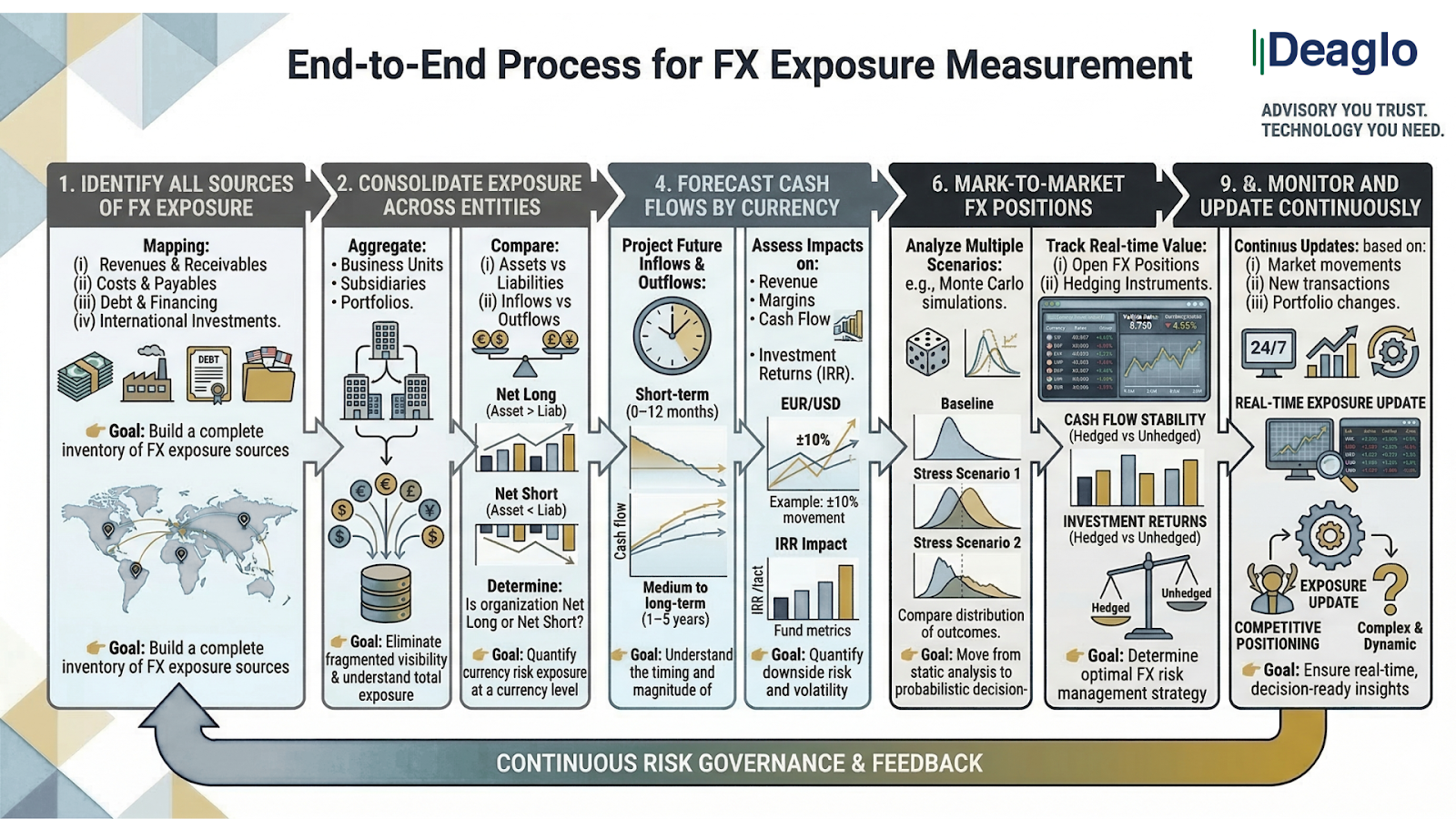
Organizations typically assess FX exposure through:
- Net exposure calculations (assets vs liabilities per currency)
- Cash flow forecasting by currency
- Sensitivity analysis (FX shocks)
- Scenario simulations (Monte Carlo models)
- Mark-to-market valuation of positions
The Role of Technology in Measuring FX Exposure
Modern FX risk management platforms enhance the way organizations measure and manage FX exposure by providing:
- Real-time FX exposure visibility across entities, portfolios, and currencies
- Scenario-based outcome analysis to evaluate potential financial impacts under different market conditions
- Hedged vs unhedged comparisons to support data-driven decision-making
Platforms like Deaglo Intelligence enable corporates and investment funds to move beyond static reporting and gain a dynamic, forward-looking view of foreign currency exposure.
Challenges in Managing FX Exposure
Managing FX exposure (foreign currency exposure) remains a significant challenge for many organizations, particularly those operating across multiple currencies and entities. Despite the importance of FX risk management, many firms still rely on outdated and fragmented processes.
Many organizations continue to depend on:
- Spreadsheets: Manual processes that are prone to errors and lack scalability
- Fragmented data systems: Disconnected sources of exposure across entities and portfolios
- Static reporting: Delayed insights that do not reflect real-time market conditions
Impact of Poor FX Exposure Management
These limitations result in:
- Limited visibility: Inability to see total FX exposure across currencies and entities
- Delayed decision-making: Slow response to market movements and missed hedging opportunities
- Increased operational risk: Higher likelihood of errors, inconsistencies, and financial misstatements
How to Manage Foreign Currency Exposure
Managing FX exposure (foreign currency exposure) requires selecting the right hedging strategy based on cash flow timing, risk tolerance, and financial objectives. The following FX hedging strategies are commonly used by corporates and investment funds to reduce currency risk exposure and improve financial predictability.
.png)
How to Choose the Right FX Hedging Strategy
The optimal approach to managing FX exposure depends on:
- Time horizon: Short-term vs long-term exposure
- Risk tolerance: Full protection vs partial flexibility
- Cash flow certainty requirements
- Cost of hedging vs potential FX impact
The Role of Technology in FX Exposure Management
Modern FX risk management requires:
- Centralized exposure visibility across entities
- Real-time mark-to-market tracking
- Scenario simulation for decision-making
- Strategy evaluation using real pricing logic
- Audit-ready reporting and governance
Platforms like Deaglo Intelligence transform FX exposure management by:
- Replacing spreadsheets with a live intelligence layer
- Enabling simulation of market impacts on IRR, margins
- Supporting defensible, data-driven decision-making
Key Takeaways
- Foreign currency exposure is the risk of financial loss due to exchange rate changes
- It affects cash flows, financial statements, and long-term value
- There are three main types: transaction, translation, and economic exposure
- Effective management requires both strategy and technology
- Real-time visibility and simulation are critical for modern decision-making
Conclusion
As global markets become increasingly interconnected, foreign currency exposure is no longer a back-office concern—it is a core financial risk driver.Organizations that rely on fragmented tools and reactive strategies risk losing control over their financial outcomes. Those that adopt structured, technology-driven approaches can turn FX from a risk into a strategic advantage.
Turn FX Exposure Into Defensible Decisions - Deaglo Intelligence gives you a real-time view of currency exposure, scenario outcomes, and hedge strategies, so you can act with clarity, not guesswork. Request a Demo