.png)
FX Cashflow Risk: Managing Currency Impact on Cash Flows for Corporates and Funds
FX cashflow risk is the risk that exchange rate movements will change the value of future cash inflows and outflows in foreign currencies. It directly impacts liquidity, margins, and returns for corporates and investment funds operating across global markets, making it a key part of effective FX risk management.
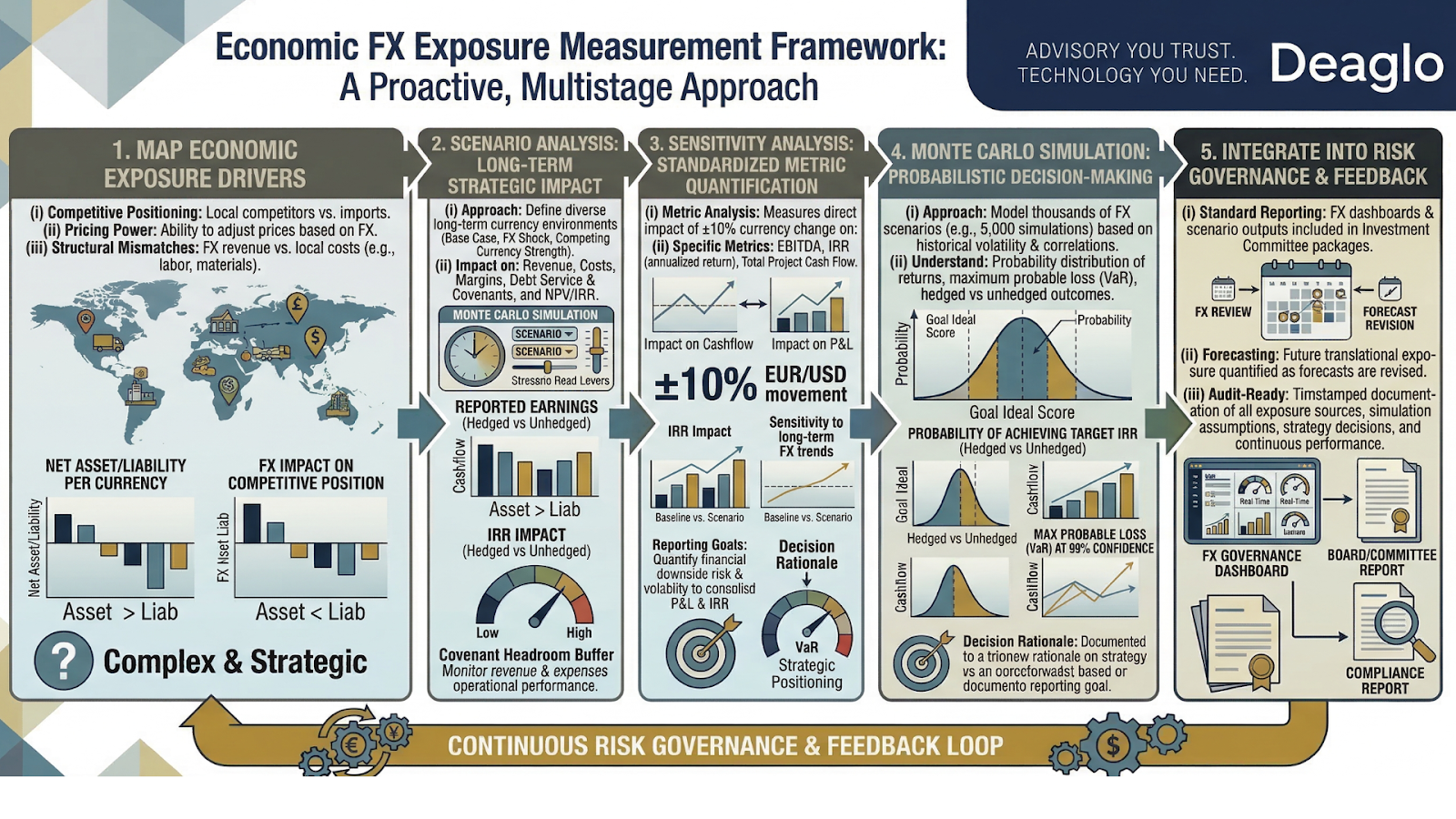
For both corporates and funds, FX cashflow risk directly affects:
- Cash flow predictability
- Liquidity planning
- Profit margins and returns
- Financial stability
FX cashflow risk is the uncertainty in future cash flows caused by currency fluctuations.
Why FX Cashflow Risk Matters for Corporates and Funds
FX cashflow risk is a critical component of FX risk management for organizations operating in global markets. For both corporates and investment funds, currency movements directly impact cash flow predictability, liquidity, margins, and realized returns.
- Export revenues in foreign currencies (e.g., EUR, GBP, MXN)
- Import costs and supplier payments denominated in USD or other currencies
- Foreign currency debt and interest payments
Impact on Corporates:
Currency volatility can create cash flow mismatches between inflows and outflows, leading to:
- Margin compression despite stable operations
Reduced earnings visibility and forecasting accuracy
Increased pressure on working capital and liquidity
This is particularly relevant for US corporates with European or emerging market exposure, where FX movements can significantly affect financial performance
For Investment Funds
Investment funds deploying capital internationally face FX cashflow risk across the investment lifecycle:
- Portfolio company cash flows generated in local currencies
- Dividend distributions to the fund
- Capital repatriation and exit proceeds
Impact on Investment Funds:
FX movements can lead to:
- Lower realized returns when converting local currency cash flows into USD
- Reduced distributable cash to investors
- Increased variability in fund-level performance and timing of cash flows
This is especially critical for funds investing in Latin America, Europe, and other cross-border markets, where currency volatility can materially impact IRR and investor outcomes, even when underlying asset performance remains strong.
Types of FX Cashflow Risk
FX cashflow risk arises from multiple sources across a company’s operations and investment lifecycle. For corporates and investment funds operating in global markets, exposures can stem from foreign currency revenues, costs, financing obligations, and investment cash flows.
Each type of exposure affects cash flow differently, ranging from export inflows and import payments to debt servicing and dividend distributions. Understanding these components is critical for identifying where currency risk exists and applying targeted FX risk management strategies.
For cross-border businesses and investors, mapping these exposure types enables better cash flow planning, hedging decisions, and financial stability across different currency environments.

Real-World Examples of FX Cashflow Risk
FX cashflow risk is best understood through real-world scenarios where exchange rate movements directly impact future cash inflows, liquidity, and returns for corporates and investment funds operating across global markets.
Corporate Example: EUR/USD Cash Flow Exposure
A US-based company expects to receive €10 million in 6 months from European operations.
- At an exchange rate of 1 EUR = 1.10 USD, the company expects to receive $11 million
- If the euro depreciates to 1.00 USD, the actual cash received declines to $10 million
Impact on Corporates:
- 1 million shortfall in expected cash flow due to currency movement
- Reduced liquidity and working capital availability
- Margin pressure despite stable sales and operational performance
Key Insight: FX cashflow risk can reduce realized cash inflows even when underlying business performance remains unchanged, making it critical for US corporates with European revenue exposure.
Fund Example: Cash Flow Repatriation Risk (MXN/USD)
A US-based investment fund receives MXN 200 million in dividends from a Mexican portfolio company.
- At 1 USD = 20 MXN, expected inflow is $10 million
- If the Mexican peso depreciates to 25, the realized cash flow falls to $8 million
Impact on Investment Funds:
- Lower distributable cash available to investors
- Reduced realized returns and potential IRR impact
- Increased variability in fund-level cash flow timing
Key Insight: For funds investing in Latin America and other emerging markets, FX cashflow risk can significantly affect investor outcomes, even when portfolio companies perform strongly in local currency terms.
FX Cashflow Risk vs Other FX Risks
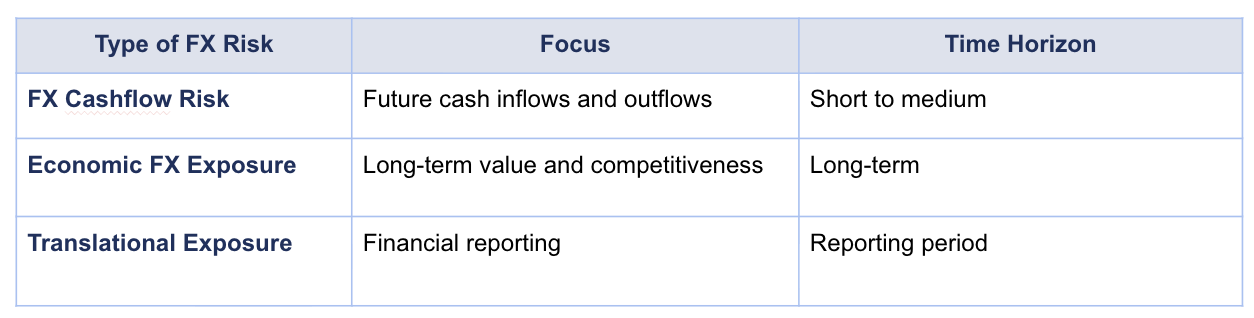
FX cashflow risk is one of several key components of FX risk management, but it differs in both timing and impact. While FX cashflow risk focuses on short- to medium-term cash inflows and outflows, economic FX exposure affects long-term business value and competitiveness, and translational exposure impacts financial reporting and balance sheet conversion.
Understanding these differences is critical for corporates and investment funds operating across global markets, as each type of FX risk requires a different management approach, time horizon, and strategy
How to Measure FX Cashflow Risk
To manage FX cashflow risk effectively, corporates and funds must quantify future exposures and assess potential currency movements.
Key Approaches
- Cash flow forecasting across currencies and time horizons
- Sensitivity analysis to measure FX impact on liquidity
- Scenario analysis for different market environments
- Rolling exposure tracking across portfolios and entities
These methods enable better planning, hedging decisions, and risk visibility.
Strategies to Manage FX Cashflow Risk
Managing FX cashflow risk requires a combination of financial tools and strategic planning to protect future cash flows from currency volatility. Corporates and investment funds operating across global markets can use approaches such as financial hedging, natural hedging, diversification, and scenario-based analysis to reduce uncertainty and improve cash flow predictability.
By aligning hedging strategies with business and investment objectives, organizations can stabilize liquidity, protect margins, and optimize returns across different currency environments.
The Role of Technology in FX Cashflow Risk Management
Managing FX cashflow risk at scale requires more than manual tracking and spreadsheets, it demands real-time visibility and forward-looking analytics. For corporates and investment funds operating across global markets, technology enables a structured and proactive approach to managing currency-driven cash flow volatility.
Modern FX risk management platforms provide:
- A centralized view of multi-currency cash flows across entities and portfolios
- Real-time exposure tracking to monitor changing currency positions
- Scenario simulation to assess the impact of FX movements on liquidity and planning
- Automated reporting to support governance, compliance, and decision-making
By leveraging technology, organizations can move from reactive cash flow management to data-driven, forward-looking FX risk management, improving liquidity planning, forecasting accuracy, and overall financial performance.
Deaglo Intelligence: Managing FX Cashflow Risk
Deaglo Intelligence enables corporates and investment funds to effectively manage FX cashflow risk through a unified, data-driven platform.
With Deaglo Intelligence, organizations can:
- Quantify FX cashflow risk across entities, portfolios, and currencies
- Simulate the impact of currency movements on future cash flows and distributions
- Compare hedging strategies using real pricing logic, not static assumptions
- Replace fragmented spreadsheets with a centralized intelligence layer
From reactive cash flow management to proactive, data-driven FX decision-making, improving liquidity planning and financial outcomes in global markets.
Best Practices for Managing FX Cashflow Risk
Effective FX cashflow risk management requires a structured, forward-looking approach. By integrating FX risk into treasury planning, maintaining rolling exposure forecasts, and aligning hedging strategies with liquidity and investment objectives, corporates and funds can reduce uncertainty in future cash flows.
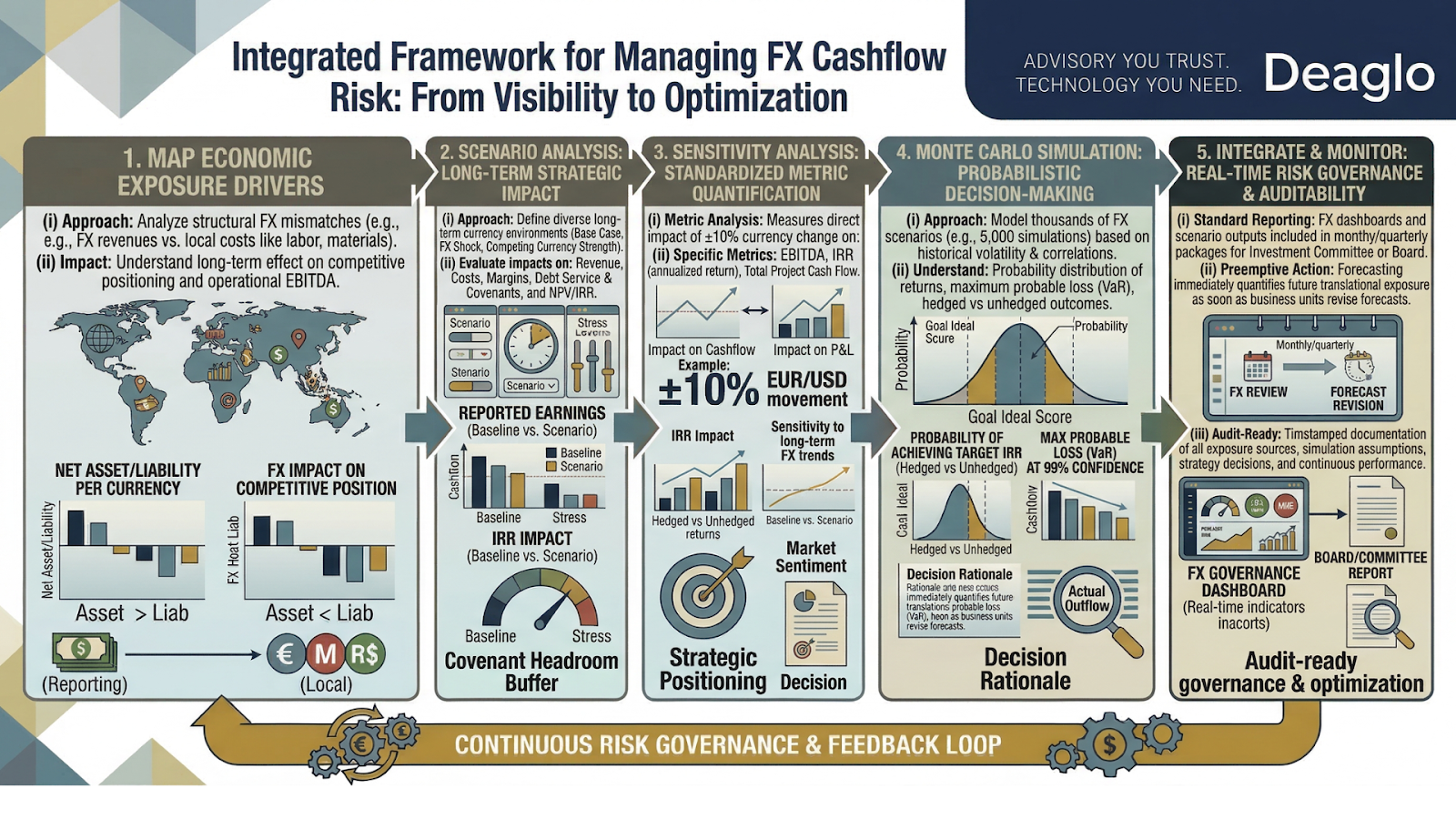
Continuous monitoring and technology enable scalable, data-driven decision-making, helping organizations protect liquidity, stabilize margins, and improve financial outcomes across global markets.
Conclusion
FX cashflow risk is a critical component of FX risk management for both corporates and investment funds, directly influencing liquidity, margins, and realized returns in cross-border environments.
Organizations that adopt structured, forward-looking, and technology-driven approaches will be better positioned to:
- Protect cash flows and margins from currency volatility
- Stabilize returns and investor distributions
- Improve forecasting accuracy and liquidity planning
- Make confident, data-driven cross-border financial decisions