Is Your FX Strategy Actually Working?
Most companies that hedge foreign exchange risk cannot prove that it is helping. An FX diagnostic changes that.
Ask a CFO whether their company hedges foreign exchange risk and the answer is usually yes. Ask them whether that hedging program is working — whether it is aligned to their actual exposure, cost-effective, and consistent with their own policy — and the answer becomes considerably less certain. That gap between activity and accountability is where most FX risk quietly disappears.
The FX diagnostic exists to close that gap. It is not a product. It is not a pitch. It is a structured question: Is what you are doing actually doing its job?
.png)
The Problem With Most FX Programs
Foreign exchange risk management has a measurement problem. Businesses invest in hedging programs — forward contracts, structured options, multi-currency accounts — and then rarely return to evaluate whether those investments are delivering. The program runs, trades get executed, and the assumption is that because something is happening, the risk is being managed.
In practice ,that assumption is frequently wrong. Hedge positions that made sense when a policy was written two years ago may no longer reflect the organisationz's actual currency exposure. Instruments that were appropriate at a certain transaction volume may be inefficient at scale. A hedging program that was calibrated for a domestic business may be entirely misaligned for a company that has since expanded into three new markets. None of this is visible without a structured review.

This is the distinction the FX diagnostic draws. A transaction cost analysis asks whether individual trades were executed at competitive prices. That matters, but it isa narrow frame. An FX diagnostic asks whether the overall program — the strategy, not the execution — is structurally sound. The two questions are related, but they are not the same, and conflating them is one of the most common errors in corporate treasury management.

What an FX Diagnostic Actually Examines
A rigorous FX diagnostic covers six specific areas of inquiry, each of which surfaces a different category of risk or inefficiency.
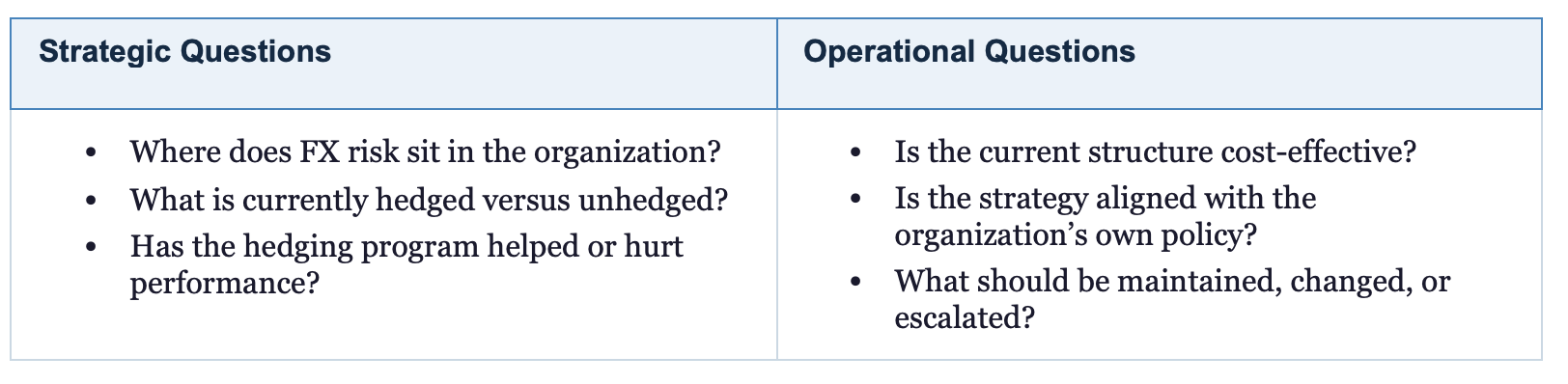
The first of these — where does FX risk actually sit — is more complex than it appears.Transaction exposure is the most visible layer: the foreign currency invoices that must be paid, the revenues that will be received in a currency other than the functional one. But translation exposure — the impact of currency moves on the reported value of foreign assets and liabilities — and economic exposure —the indirect competitive effects of exchange rate shifts on a business’s pricing power and market position — are equally real and substantially harder to quantify without a structured assessment.
The performance question is where most organizations find the most uncomfortable answers. Hedge performance is rarely evaluated on a like-for-like basis against an unhedged benchmark. Without that comparison, it is impossible to determine whether the program has added or subtracted value — and organizations that have been hedging in adverse market conditions may have been paying to reduce riskin ways that cost more than the risk itself was worth.

Three Versions, One Purpose
Not every FX diagnostic needs to be the same depth of engagement. The appropriate version depends on where the organization is in its understanding of its own FX exposure, the complexity of the portfolio, and the stage of the advisory relationship.
The Light Diagnostic is AI-generated from submitted client data. It is fast, scalable, and best suited to early-stage conversations where the primary goal is to surface whether a deeper review is warranted. It opens the door; it does not close the analysis. Its current limitation — the absence of a standardized output format — means its quality varies by engagement, and this is a problem that requires a structural fix rather than individual effort to resolve.
The Hybrid Diagnostic — AI generation combined with human validation by the risk team— is the recommended default for the sales motion. It combines the operational efficiency of automated analysis with the credibility and contextual judgement that only experienced practitioners can apply. The AI identifies patterns; the risk team determines which patterns are meaningful, which reflect data artefacts, and what the implications are for the specific client. The output is structured, client-ready, and defensible.
The Full Pro Diagnostic is an advisory-led engagement covering portfolio-level analysis, pricing efficiency, liquidity, and formal policy compliance review.It is a paid engagement and appropriate for existing clients with complex, multi-currency exposures or for organizations where the diagnostic findings are expected to inform board-level decisions.

The Data That Makes It Work
The quality of an FX diagnostic is entirely determined by the quality of the data it starts from. This is not a methodological preference — it is a practical constraint.An exposure analysis conducted on incomplete trade data will produce an incomplete picture of hedge coverage. A policy alignment review conducted without the policy document produces no alignment review at all.
The minimum data requirement is three inputs: the client’s FX exposure data across payables, receivables, and balance sheet positions; the historical and outstanding FX trade record; and the hedging policy, if one exists. Where budget FX rates, NAV or IRR targets, credit facility terms, or liquidity constraints are available, they materially improve the depth of the analysis —but they are not blockers.
A critical operational principle governs the data collection process: sales should not be interpreting data. Their role is to collect and submit it. Interpretation is the risk team’s responsibility. Maintaining this boundary is what makes the diagnostic scalable — it removes the inconsistency that comes from having different individuals make different judgements about what the data means before it has been formally reviewed.

Where the FX Diagnostic Fits the Sales Motion
The FX diagnostic is not a product feature. Its role in the sales motion is to replace the pitch with a question. The question — Are you confident your current FX strategy is actually working? — creates a different kind of conversation than a rate comparison or a product demonstration. It creates doubt, not persuasion, and doubt that is grounded in a legitimate analytical concern rather than a sales objective is far more durable.
That doubt, once established, converts naturally into a diagnostic engagement. The diagnostic engagement, once delivered, converts naturally into advisory or execution — because the findings are specific, the gaps are quantified, and there commended actions are concrete. The transition from diagnostic to commercial engagement does not require a second pitch. The evidence makes the case.

The account manager owns the diagnostic from first conversation to final delivery. This includes coordinating data collection, triggering the audit process, working with the risk team on the validation layer, and presenting findings to the client contact. Ownership matters because the diagnostic is a client-facing commitment — the moment it is introduced as an offering, the organization is accountable for the quality and timeliness of its delivery.
What Scalability Actually Requires
An FX diagnostic that produces inconsistent outputs is not a diagnostic — it is a series of bespoke analyses that happen to share a name. Scalability requires three things to be true simultaneously, and none of them can compensate for the absence of the others.
The first is standardized data input. If each engagement begins with a different data collection process, the audit will start from a different baseline every time. The standardized data requirement — exposure data, trade history, hedging policy — exists precisely to prevent this. It is the consistency of the input that makes the output comparable across engagements.
The second isa defined workflow. The four stages — data intake, AI generation, human validation, report structuring — must be followed in sequence and owned clearly at each step. Skipping the human validation layer in the interest of speed produces outputs that are fast but unreliable. Skipping the structured delivery step produces findings that are accurate but unusable in a client conversation.
The third is a standardized output template. Without it, every diagnostic looks different, and the organization cannot build on its own institutional knowledge of what good FX diagnostic output looks like. A marketing-approved PDF template is nota cosmetic requirement — it is what turns an analytical capability into a repeatable product.