Why Your FX Process Is Costing More Than the Hedge — A Corporate Treasury Framework
Most discussions around foreign exchange (FX) costs focus on spreads, pricing, and execution fees. However, for corporate treasury teams, the true cost of FX risk often lies beyond the trade itself, it’s embedded in the FX risk management process.
.png)
Inefficiencies in currency exposure management create hidden costs, including:
- Hours spent on manual scenario modeling in spreadsheets
- Limited visibility of FX exposure across entities and cash flows
- Risks identified only after currency movements impact financial performance
Over time, these gaps in FX risk management frameworks compound, leading to earnings volatility, reduced margins, and weaker confidence in decision-making. The real challenge isn’t just execution cost, it’s the absence of a structured, data-driven FX risk management process.
The hidden cost of FX isn’t the hedge. It’s the process
In corporate treasury, the true cost of foreign exchange (FX) risk management isn’t just the hedge, it’s the process behind it. When FX exposure management is handled through fragmented workflows, inefficiencies begin to compound.
Treasury teams are often forced to:
- Operate without a centralized view of currency exposure
- Rely on manual FX analysis that doesn’t scale across entities
- Make hedging decisions under time pressure without proper scenario validation
This disconnect creates a critical gap between FX strategy and execution, and that gap is where hidden costs build, impacting profit margins, cash flow stability, and financial performance over time.
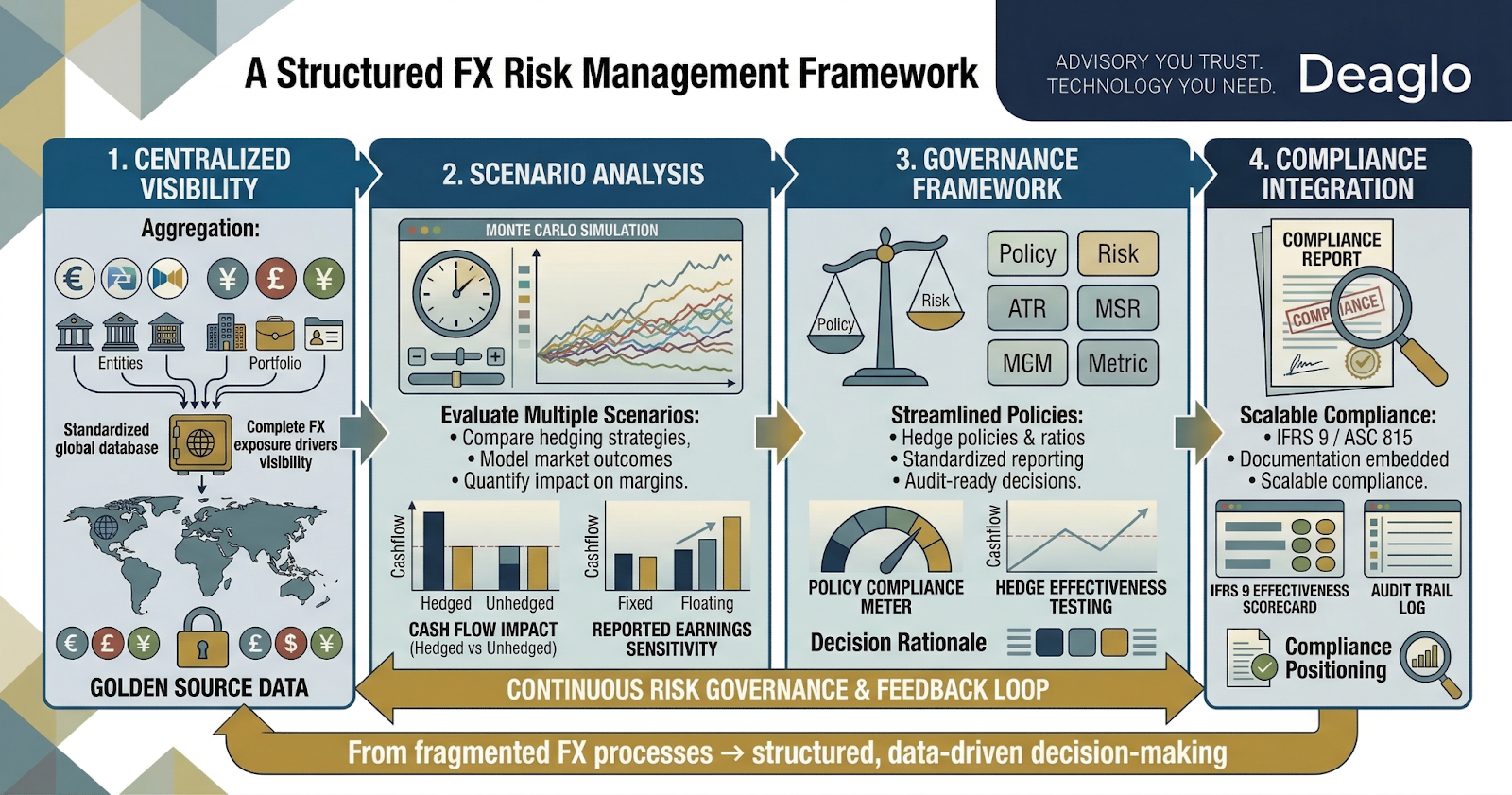
1. Consolidating FX Exposure into a Single View
For many corporates, foreign exchange (FX) exposure is fragmented across:
- Multiple entities and geographies
- Business units
- Disconnected systems and spreadsheets
This fragmentation makes it difficult to answer a fundamental treasury question:
Where does our currency risk actually sit?
Leading treasury teams solve this by implementing centralized FX exposure management, bringing together:
- Forecast and actual cash flows across currencies
- Balance sheet exposures (assets and liabilities)
- Existing hedge positions and hedge coverage
The result: complete, real-time FX exposure visibility, enabling confident, data-driven decision-making across the organization.
2. Why Scenario Analysis Should Come Before Every Hedge
Hedging decisions are often reactive, driven by market volatility or internal pressure.
Without FX scenario analysis, teams are effectively making decisions without understanding:
- Downside risk exposure
- Cost vs protection trade-offs
- Impact on cash flow, margins, and earnings volatility
A structured approach evaluates strategies before execution:
- How does a forward contract vs FX options strategy compare?
- What happens under different currency market scenarios?
- How does the hedge align with business and financial objectives?
The result: a shift from reactive hedging to proactive, data-driven FX risk management.
3. Building a Modern, Auditable FX Governance Framework
Effective FX risk management in corporate treasury requires more than execution, it requires governance, consistency, and accountability.
A modern framework includes:
- Clearly defined FX hedging policies and hedge ratios
- Documented decision-making processes
- Standardized, board-ready reporting across entities
Most importantly, it ensures every decision can be:
- Explained
- Repeated
- Defended
This is critical for internal governance, board oversight, and audit readiness.
4. Reducing IFRS 9 / ASC 815 Documentation Friction
One of the biggest operational challenges in FX hedge accounting is compliance with IFRS 9 and ASC 815 requirements, including:
- Detailed hedge documentation
- Ongoing hedge effectiveness testing
- Clear linkage between hedges and underlying exposures
When managed manually, this becomes:
- Time-consuming
- Error-prone
- Difficult to scale across entities
Leading treasury teams reduce this friction by integrating compliance into their FX risk management process, rather than treating it as a separate task.
The result: embedded, scalable compliance that supports both operational efficiency and regulatory requirements.
From Fragmented Process to Structured System
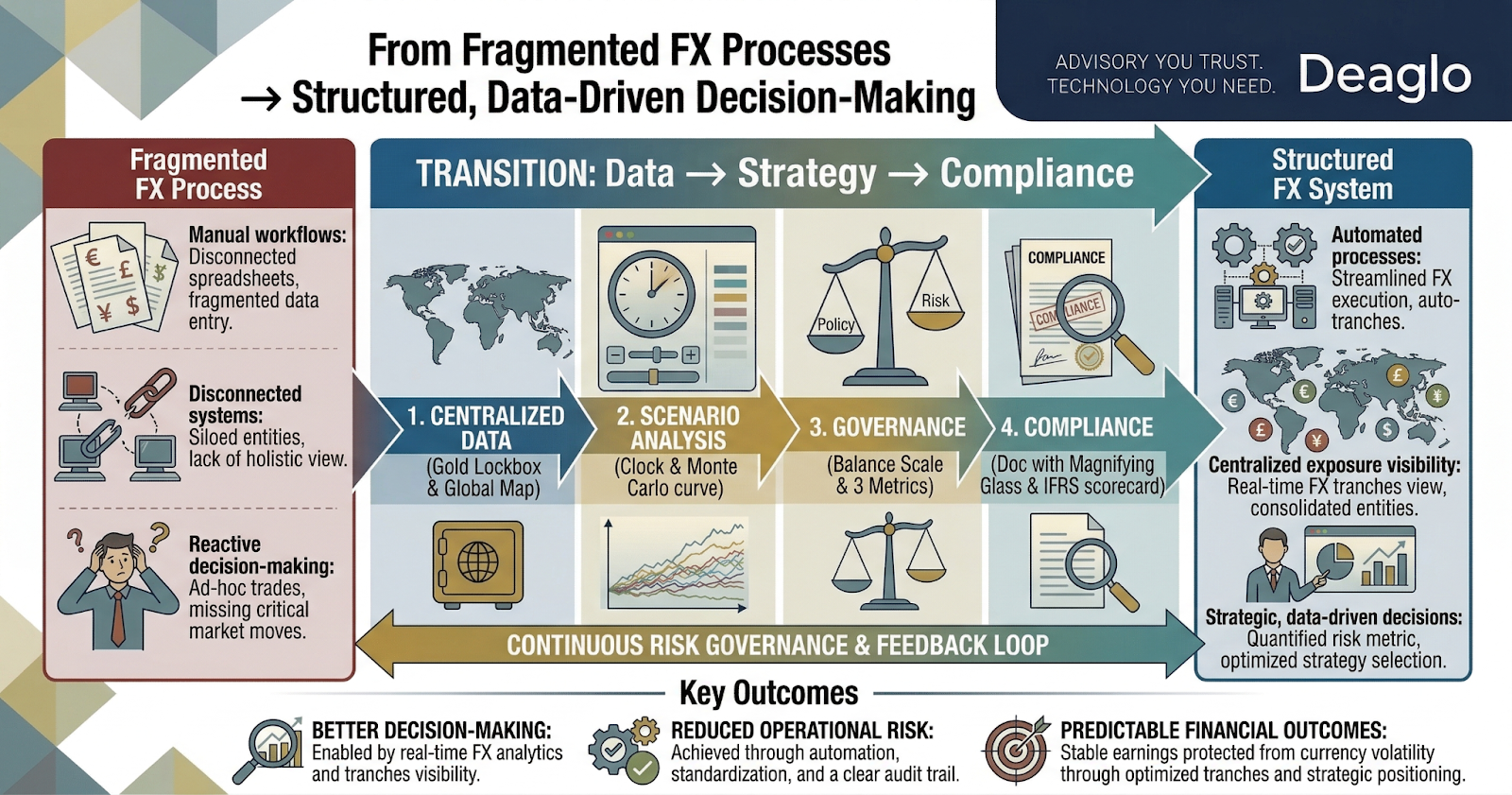
When these elements come together, corporate treasury teams transform their FX risk management process from:
- Manual workflows → Automated FX processes
- Fragmented systems → Centralized FX exposure visibility
- Reactive hedging → Strategic, data-driven decision-making
The impact:
- Improved decision-making through real-time FX analytics and scenario insights
- Reduced operational risk by minimizing manual errors and inefficiencies
- More predictable financial outcomes, with greater control over cash flows, margins, and earnings volatility
A structured approach enables scalable, consistent, and proactive FX risk management across global operations.
Where Most Teams Get Stuck in FX Risk Management
Even when the need for a structured FX risk management framework is clear, execution is often constrained by:
- Legacy processes that rely on manual workflows and spreadsheets
- Disconnected systems that limit centralized currency exposure visibility
- Limited internal bandwidth to implement and scale treasury solutions
As a result, many organizations plateau aware of their FX risk exposure, but unable to operationalize a scalable, data-driven FX risk management strategy across the business.