FX Risk in Fundraising: The LP Conversation Most GPs Still Aren’t Having
FX risk is now a core due diligence factor in fundraising.
Institutional LPs expect fund managers to demonstrate:
- A portfolio-level FX strategy
- Clear cost of carry implications
- Transparent impact on IRR and distributions
GPs who cannot answer these questions clearly risk slowing or losing allocations.
.png)
Why FX Risk Is Now a Fundraising Issue
LP expectations have shifted from awareness to accountability.
FX risk is now evaluated as part of:
- Return attribution (what drove performance)
- Risk governance (how exposure is managed)
- Manager sophistication (institutional readiness)
What LPs Are Asking
- What is your FX strategy across the portfolio?
- How does FX impact net returns?
- What is the cost of hedging vs. not hedging?
Key Insight: If FX is not clearly structured and communicated, it introduces uncertainty into LP decision-making.
The Gap: Deal-Level vs. Portfolio-Level FX Management
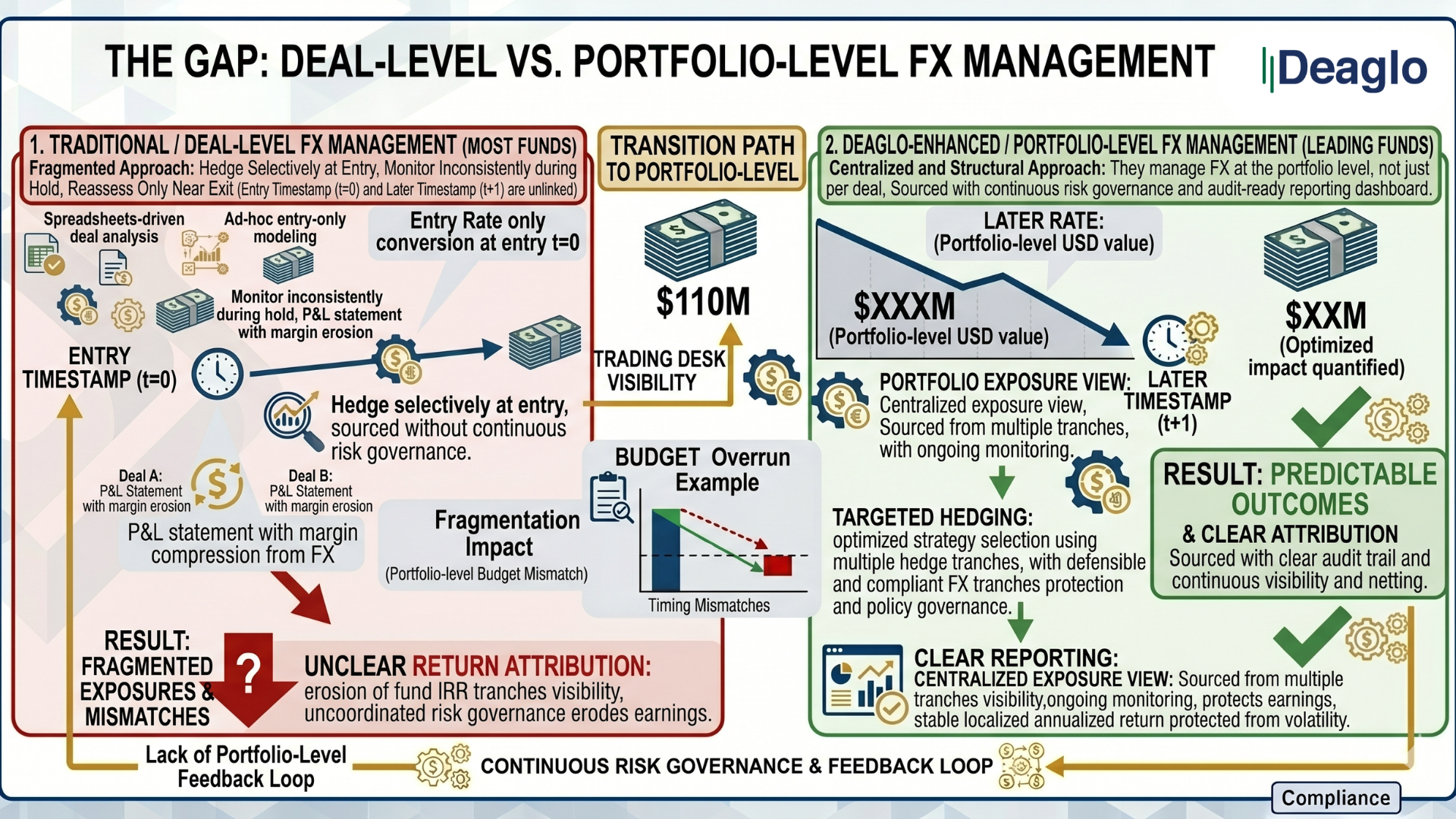
Most funds:
- Hedge selectively at entry
- Monitor inconsistently during hold
- Reassess only near exit
This creates:
- Fragmented exposures
- Timing mismatches
- Unclear return attribution
What Leading Funds Do Differently?
They manage FX at the portfolio level, not just per deal.
What a Portfolio-Level FX Framework Looks Like
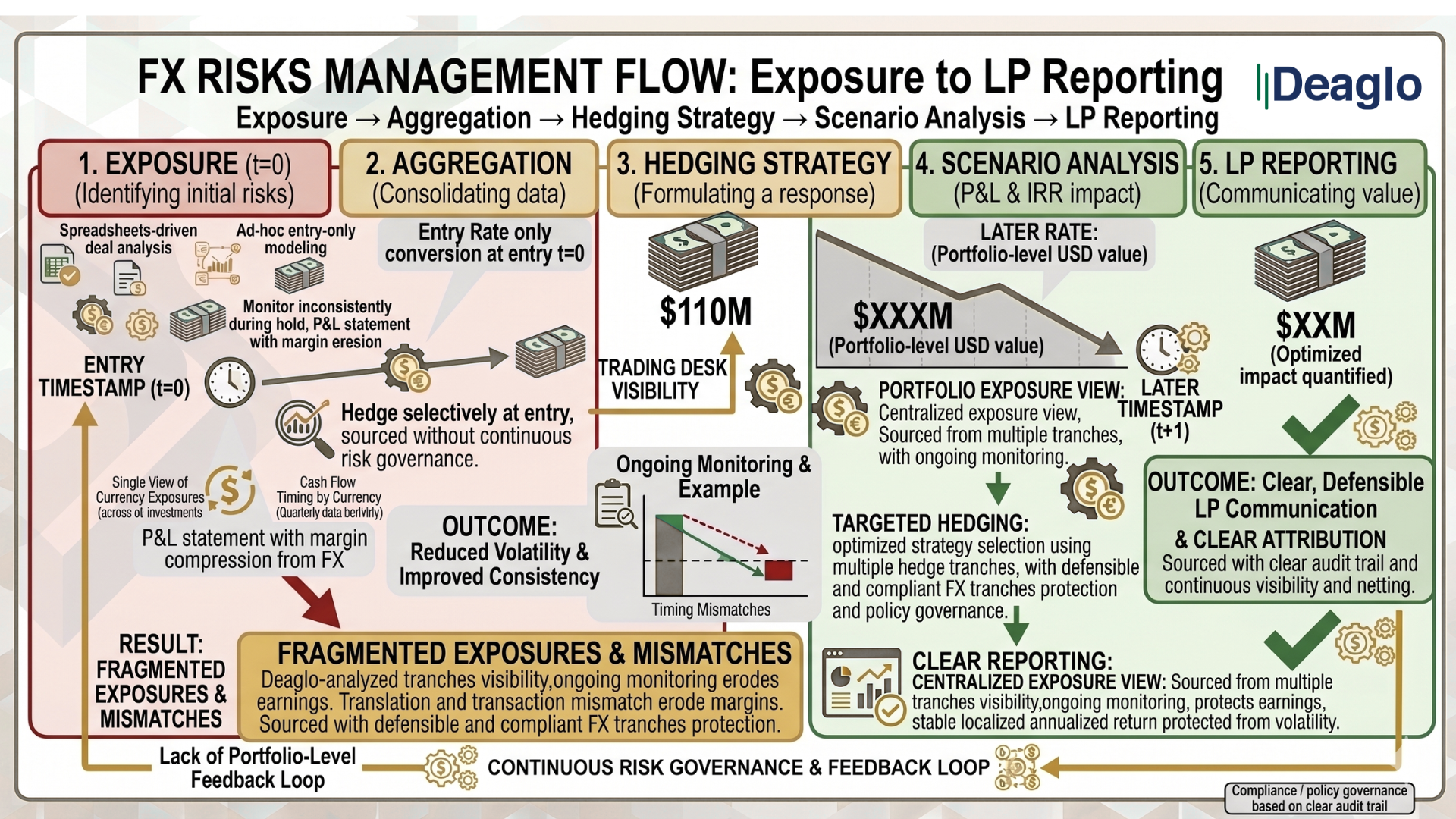
1. Centralized Exposure Visibility
A single view of:
- Currency exposures across all investments
- Cash flow timing by currency
- Mark-to-market sensitivity
Outcome: Faster, data-driven decisions.
2. Structured Hedging Strategy
Instead of one-off trades:
- Layered hedging programs
- Rolling hedge ratios
- Scenario-driven adjustments
Outcome: Reduced volatility and improved consistency.
3. IRR and Cash Flow Impact Analysis
Funds quantify:
- Hedged vs. unhedged returns
- Currency-driven performance changes
- Downside risk scenarios
Outcome: Clear, defensible LP communication.
Cost of Carry: The Question LPs Are Now Asking
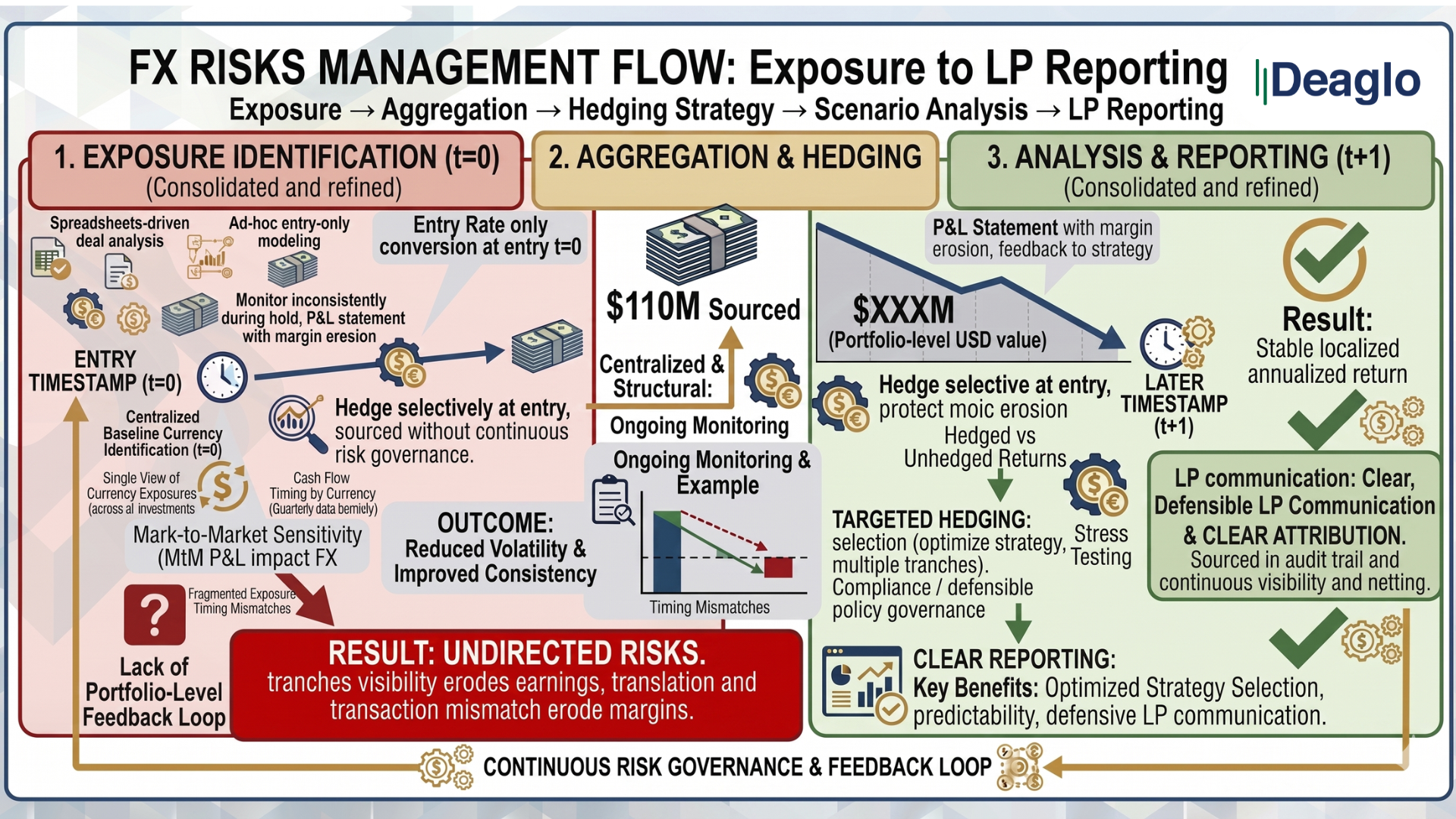
Cost of carry is the cost or benefit of maintaining an FX hedge, driven by interest rate differentials between currencies, and directly impacts net fund returns.
LPs are increasingly focused on:
- Whether hedging improves risk-adjusted returns
- The trade-off between protection and cost
- Consistency of decision-making
Best Practice
Leading GPs present:
- Scenario comparisons (hedged vs. unhedged)
- IRR impact across market environments
This shifts the narrative from: “We hedge to reduce risk”
To: “Here is the quantified impact of our FX strategy.”
Capital Efficiency: Why Hedging Structure Matters
Access to uncollateralised hedging lines is becoming a differentiator.
Why It Matters
- Preserves capital for deployment
- Avoids margin drag
- Enables scalable hedging
What It Signals to LPs
- Institutional infrastructure
- Strong counterparty relationships
- Efficient capital management
Case Study: FX Strategy as a Fundraising Advantage
A fund with significant EM exposure faced LP resistance due to:
- Unclear FX impact on returns
- Limited reporting transparency
- Perceived currency risk
Solution
They implemented:
- Portfolio-wide FX exposure tracking
- Hedged vs. unhedged scenario analysis
- Standardized LP reporting
Case Study: FX Strategy as a Fundraising Advantage
A fund with significant EM exposure faced LP resistance due to:
- Unclear FX impact on returns
- Limited reporting transparency
- Perceived currency risk
Solution
They implemented:
- Portfolio-wide FX exposure tracking
- Hedged vs. unhedged scenario analysis
- Standardized LP reporting
Result
- Increased LP confidence
- Faster investment committee approvals
- Successful close after initial delays
Key Insight: FX strategy became a fundraising enabler , not just a risk tool
Where Most GPs Still Fall Short
Common Challenges
- Disconnected systems and spreadsheets
- Limited internal FX expertise
- Lack of real-time exposure visibility
Impact
- Reactive decision-making
- Weak LP communication
- Missed hedging opportunities
Turning FX Into a Competitive Advantage
GPs turn FX into a competitive advantage by implementing portfolio-level exposure management, structured hedging strategies, and transparent LP reporting that clearly links currency risk to fund performance.
Leading funds use FX to:
- Improve return predictability
- Strengthen LP trust
- Differentiate in competitive fundraising
Conclusion
FX is no longer a secondary consideration.
It is:
- A driver of returns
- A test of governance
- A signal of institutional maturity
The real question is no longer: Do you manage FX risk?
It is: Can you explain and defend your FX strategy at the portfolio level?
Make FX a Defensible Part of Your Investment Strategy
Understand your portfolio exposure, quantify hedging impact, and communicate FX strategy with clarity, all in one place.Explore Deaglo Intelligence