Is FX Risk Quietly Eroding Your Margins? A Corporate Treasury Framework
For companies operating across borders, foreign exchange (FX) risk often goes undetected in real time but materializes later as earnings volatility, financial reporting impacts, and board-level scrutiny. By the time it is identified, currency fluctuations are already embedded in performance, making FX risk management, currency exposure monitoring, and cross-border risk mitigation strategies essential for maintaining financial stability and informed decision-making.
.png)
What is FX risk in corporate treasury?
Foreign exchange (FX) risk in corporate treasury refers to the impact of currency fluctuations on a company’s financial performance, including revenues, costs, and cash flows across multiple currencies.
For companies with international operations, FX risk directly affects:
- Profit margins through unfavorable exchange rate movements
- Forecast accuracy due to currency volatility
- Financial reporting and consolidated earnings across regions
Effective FX risk management and currency exposure monitoring are essential to protect cash flows, stabilize earnings, and support better financial decision-making.
The problem isn’t awareness. It’s structure.
The challenge in FX risk management for corporate treasury isn’t awareness, it’s structure. Most treasury teams recognize their foreign exchange (FX) exposure, but lack a structured framework to measure exposure, model currency risk, and execute proactive hedging strategies.
As a result, common gaps across corporate finance teams include:
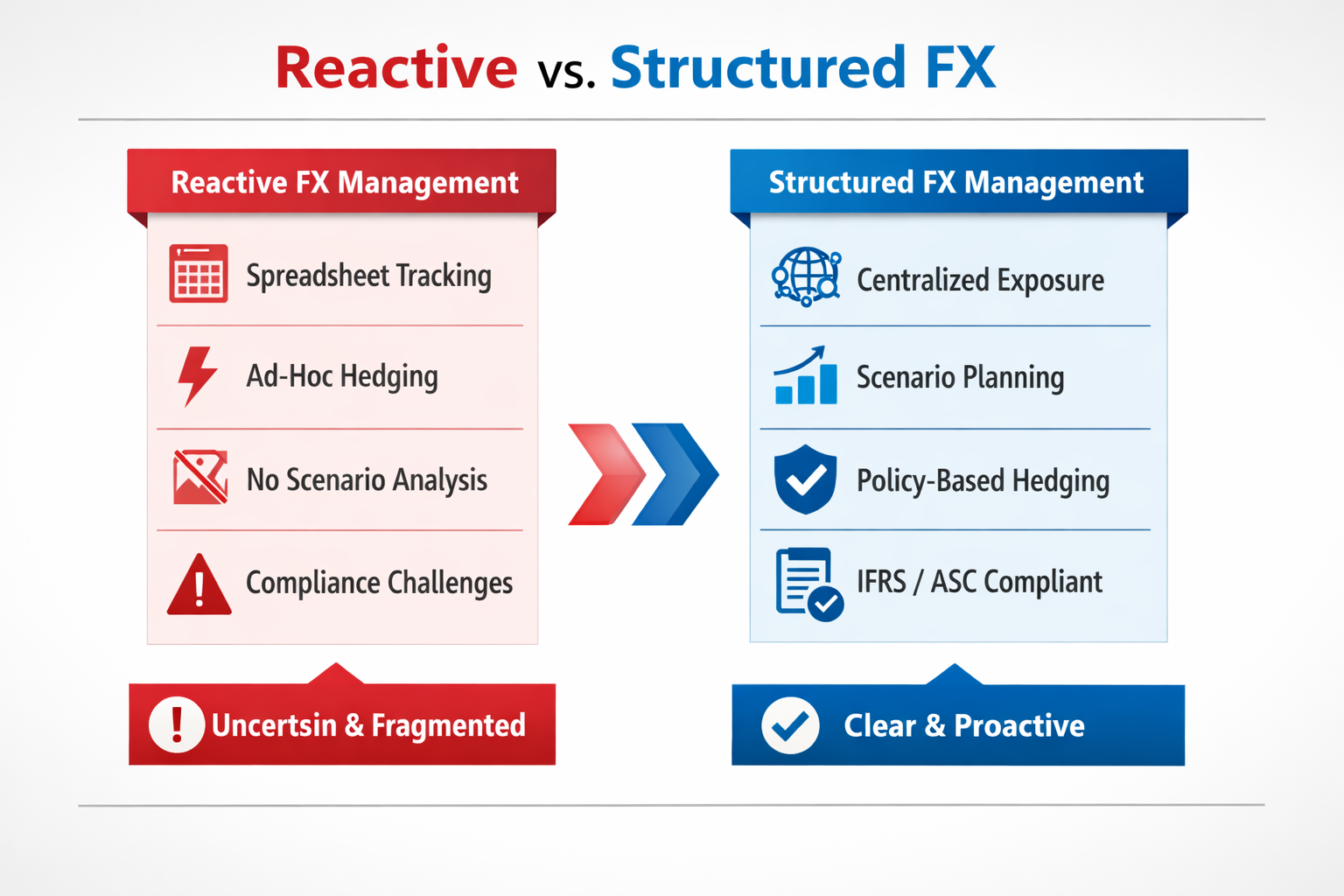
- Fragmented exposure tracking across spreadsheets with no centralized view
- Reactive hedging decisions made under time pressure instead of strategic planning
- Limited or no scenario analysis before executing FX strategies
- Ongoing IFRS 9 and ASC 815 compliance challenges, creating documentation friction
This highlights a broader issue: not just a tooling limitation, but a process gap in FX risk management, where the absence of integrated systems and structured workflows leads to inconsistent decision-making and increased financial risk.
How do corporates manage FX risk effectively?
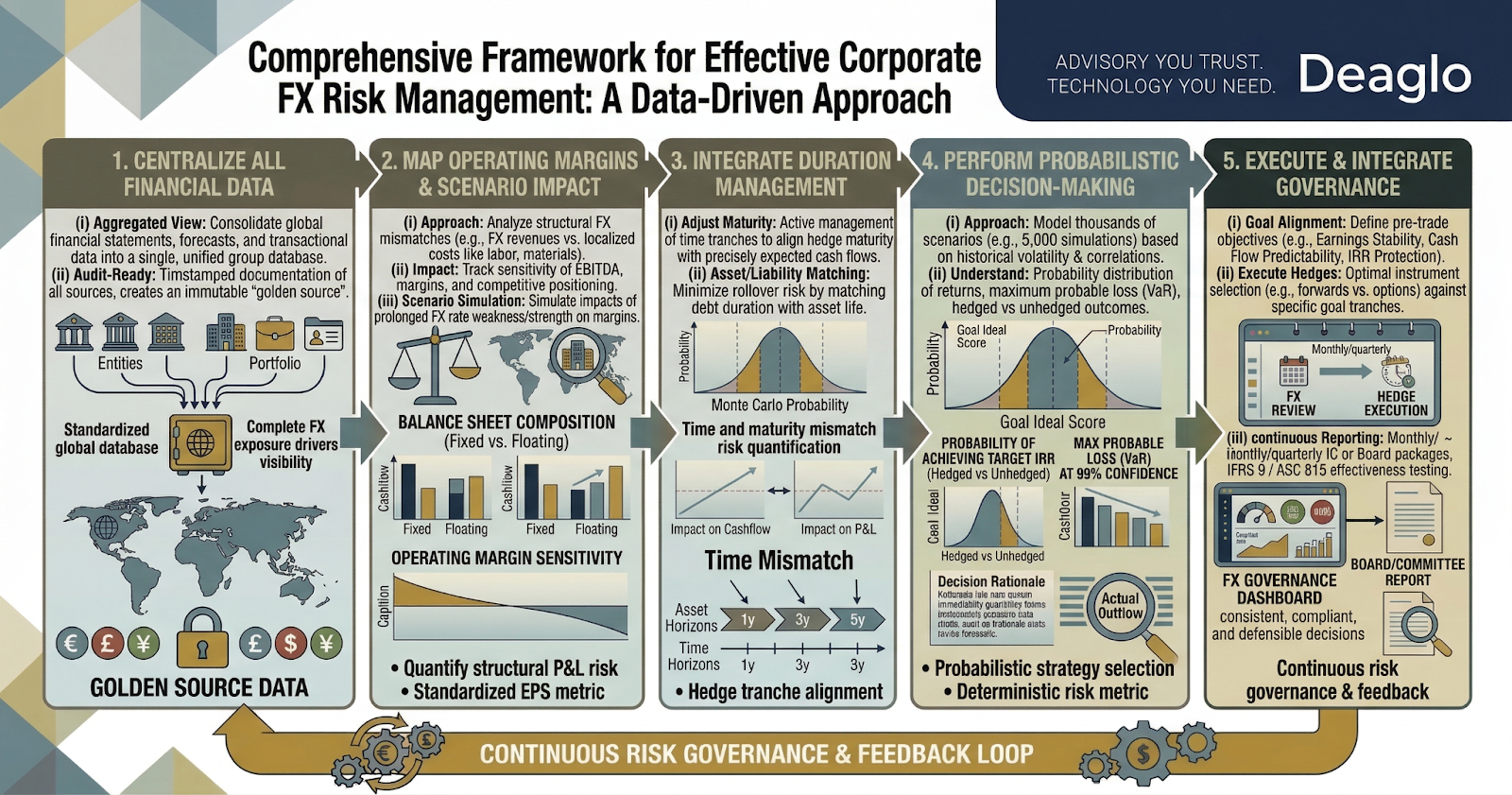
Leading treasury teams adopt a structured FX risk management framework built on the following core pillars:
What changes when this is in place?
Organizations shift from:
- Reactive FX management → Proactive risk management
- Fragmented exposure tracking → Centralized visibility across currencies
- Uncertain decisions → Defensible, data-backed treasury strategies
The result:
- Reduced earnings volatility and more stable financial performance
- Improved financial visibility across global operations and cash flows
- Faster, data-driven decision-making supported by real-time FX analytics
A structured approach transforms corporate treasury from a reporting function into a strategic driver of financial stability and performance.
Where most teams get stuck
Even with a defined FX risk management framework, execution often breaks down due to:
- Manual processes that rely heavily on spreadsheets and increase operational risk
- Fragmented systems that prevent a centralized view of currency exposure
- Limited access to real-time FX analytics for timely, informed decision-making
This is where many corporate treasury teams plateau unable to move from structured intent to scalable, data-driven execution, limiting the effectiveness of their foreign exchange risk management strategy.
A practical next step
You don’t need to overhaul your entire process to improve FX risk management. You need structure. We’ve put together a short guide outlining how corporate treasury teams are building practical, structured FX frameworks and applying them in real-world scenarios.