FX Risk Management for Investment Funds: A Structured Approach to Managing Currency Risk
.png)
Why FX Risk Matters for Investment Funds
FX risk management for investment funds focuses on controlling how currency movements affect capital deployment, portfolio returns, and investor outcomes. Funds investing across borders are inherently exposed to foreign exchange risk, whether through asset acquisitions, portfolio company operations, financing structures, or exit proceeds.
Without structured management, FX exposure can materially distort investment performance, increase return volatility, and complicate investment decision-making. Currency movements between the time capital is deployed and when returns are realized can significantly impact IRR, NAV, and cash flow predictability.
A structured FX risk management framework for funds allows investment teams to monitor currency exposure and govern FX risk with the same rigor applied to credit, market, and liquidity risk. By establishing disciplined processes and clear governance, funds can better manage cross-border investments and maintain greater transparency for investment committees and limited partners.
What Is FX Risk Management for Funds?
FX risk management for investment funds is the process of identifying, measuring, and managing how currency movements affect investments across the entire investment lifecycle, from capital calls and acquisitions to portfolio operations, distributions, and exits.
Funds investing across borders are exposed to foreign exchange risk whenever capital is deployed into assets denominated in currencies different from the fund’s base currency. Managing this FX exposure requires structured frameworks that track how exchange rate movements influence portfolio value, cash flows, and investment returns.
Unlike corporates, investment funds must manage currency risk across more complex dimensions, including:
- Multiple assets and jurisdictions across global portfolios
- Long and uncertain investment horizons tied to asset lifecycles
- Portfolio-level aggregation of FX exposure across holdings
- Investor reporting and governance requirements for transparency and oversight
The objective of FX risk management for funds is not to predict currency movements, but to reduce unintended risk, control return volatility, and prevent currency fluctuations from distorting investment outcomes.
Where FX Exposure Arises in Investment Funds
FX exposure in investment funds can arise at multiple stages of the investment lifecycle. Funds deploying capital across borders encounter foreign exchange risk whenever assets, revenues, costs, or financing structures are denominated in currencies different from the fund’s base currency.
Understanding where currency exposure originates helps funds design more effective FX risk management frameworks and maintain greater transparency in portfolio performance.

Types of FX Exposure Relevant to Funds
Investment funds typically encounter three primary forms of FX exposure, each affecting portfolio performance and reporting in different ways. Understanding these exposure types helps funds design structured FX risk management frameworks.

These three forms of FX exposure in investment funds affect portfolio performance in different ways. Transaction exposure influences near-term cash flows, translation exposure affects financial reporting, and economic exposure reflects the long-term impact of currency movements on investment value.
FX Risk Management Objectives for Investment Funds
FX risk management for investment funds focuses on controlling how currency movements affect portfolio performance, capital preservation, and investor outcomes. Because funds often deploy capital across multiple jurisdictions and currencies, managing foreign exchange risk helps maintain stability in returns and financial reporting.
Funds typically manage FX exposure to:
- Reduce return volatility caused by currency movements
- Protect capital invested in cross-border assets
- Improve predictability of portfolio cash flows
- Support investment committee governance and decision-making
- Enhance transparency and consistency in LP reporting
While the core principles of currency risk management remain consistent, specific objectives can vary depending on the fund’s strategy, structure, investment horizon, and investor expectations.
FX Risk Management vs FX Trading for Funds
For investment funds, it is important to clearly distinguish FX risk management from FX trading. While both involve foreign exchange markets, their objectives and governance frameworks are fundamentally different.
FX risk management for funds focuses on controlling how currency movements affect portfolio value, investment returns, and investor outcomes. Decisions are driven by underlying portfolio exposures and are typically governed by defined policies and investment committee oversight.
By contrast, FX trading is generally market-view driven and seeks to generate profit from short-term currency price movements.
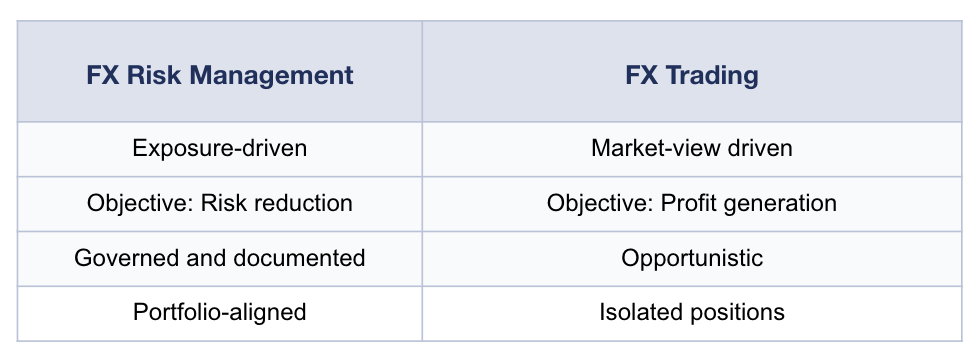
In practice, FX risk management exists to support investment outcomes and portfolio stability, rather than to create incremental return through speculative currency positions.
The FX Risk Management Process for Investment Funds
Effective FX risk management for investment funds follows a structured process that helps teams identify currency exposure, evaluate potential outcomes, and implement disciplined hedging strategies. By applying consistent frameworks across portfolio companies and investment structures, funds can manage foreign exchange risk with greater transparency and governance.
.png)
Common FX Risk Management Challenges for Investment Funds
Even well-structured FX risk management programs for investment funds can face operational and analytical challenges. Because funds often manage multiple assets across different jurisdictions and currencies, maintaining a clear view of portfolio-level FX exposure can be complex.
Common challenges include:
- Fragmented FX exposure data across portfolio companies and entities
- Limited forward-looking visibility into potential currency risk scenarios
- Inconsistent currency hedging decisions across assets or investment periods
- Heavy reliance on manual spreadsheets and disconnected reporting tools
- Difficulty aggregating portfolio-level foreign exchange risk across investments
These challenges can weaken governance, slow decision-making, and increase operational risk. Without structured frameworks and centralized analytics, funds may struggle to manage currency exposure consistently across their portfolios.
The Role of Technology in FX Risk Management for Funds
As investment portfolios become more global and complex, FX risk management for investment funds increasingly relies on technology to improve visibility, analytics, and governance. Traditional spreadsheet-based processes often struggle to track currency exposure across multiple portfolio companies, entities, and investment timelines.
Modern FX risk management platforms help funds:
- Centralize FX exposure data across portfolios and jurisdictions
- Model potential outcomes under different currency scenarios
- Compare alternative currency risk management strategies objectively
- Improve documentation, governance, and auditability of decisions
- Scale FX risk management frameworks consistently across funds and vintages
Solutions such as Deaglo Intelligence, built on Deaglo Technology, enable funds to integrate exposure data, market inputs, and scenario analytics into a unified decision framework. This allows investment teams to evaluate hedging strategies, monitor portfolio-level FX exposure, and maintain consistent governance across investment structures.
By combining analytics, automation, and structured workflows, technology-driven platforms help funds manage foreign exchange risk with greater transparency, speed, and consistency.
Governance and Best Practices for Investment Funds
Effective FX risk management for investment funds requires strong governance frameworks that ensure currency risk decisions are applied consistently and aligned with investment objectives. Clear policies and oversight structures help funds manage foreign exchange exposure with transparency and discipline.
Best-in-class FX risk management programs typically include:
- A defined FX risk policy approved by the investment committee (IC)
- Clear hedging objectives, thresholds, and decision frameworks
- Separation between risk analysis and execution functions
- Regular monitoring and performance review of hedging strategies
- Transparent LP reporting and documentation of currency risk decisions
Strong governance reduces behavioral bias, improves consistency in decision-making, and supports defensible currency risk management frameworks across the portfolio.
FX Risk Management in Volatile Markets
Periods of elevated currency market volatility can significantly amplify the impact of unmanaged FX exposure on investment funds. Sudden movements in exchange rates may affect portfolio valuations, cash flows, and realized returns across cross-border investments.
Funds with structured FX risk management frameworks are better positioned to:
- Protect capital invested across jurisdictions
- Preserve portfolio returns despite currency fluctuations
- Maintain confidence in portfolio valuations and financial reporting
During volatile market conditions, disciplined currency risk management becomes even more critical. Consistent frameworks and governance often matter more than short-term market timing when managing foreign exchange risk in global investment portfolios.
Conclusion: Managing FX Risk Across the Fund Lifecycle
For investment funds operating across borders, FX risk management is a critical component of portfolio oversight. Currency movements can influence capital deployment, portfolio performance, financing structures, and exit outcomes throughout the investment lifecycle.
By implementing structured frameworks for identifying exposure, evaluating potential outcomes, and applying disciplined risk management strategies, funds can better manage currency risk and reduce unintended return volatility. Strong governance, consistent processes, and clear reporting also support transparency for investment committees and limited partners.
As global investment portfolios grow more complex, technology-driven frameworks are increasingly important for centralizing exposure data, evaluating strategies, and maintaining consistent governance across funds and vintages.
Explore Deaglo’s solutions for investment funds to see how integrated analytics and decision frameworks can support more transparent and disciplined approaches to FX risk management and currency exposure oversight.