.png)
Global FX & Rates Market Update: What Businesses Should Watch in Q2 2026
Global markets continue to navigate a complex environment shaped by persistent inflation, elevated interest rates, geopolitical uncertainty, and diverging economic growth trends. Across currencies, rates, and emerging markets, investors are increasingly focused on resilience, carry opportunities, and central bank policy direction heading into the second half of 2026.
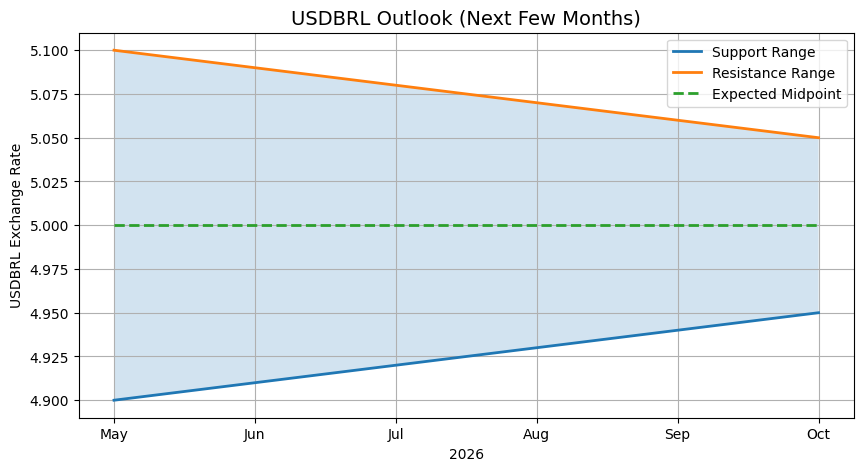
USDBRL Outlook: Brazilian Real Supported by High Interest Rates
The USDBRL pair is expected to trade within the 4.90 to 5.10 range over the coming months as Brazil’s high interest rate environment continues to support the Brazilian Real. Despite a recent rate cut, Brazil’s benchmark Selic rate remains elevated at 14.50%, significantly above the U.S. Federal Funds Rate. This large rate differential continues to attract carry trade flows into Brazil.
Brazil is also benefiting from strong commodity exports and increased foreign exchange inflows tied to energy markets. Rising oil prices and continued demand for commodities such as soybeans and iron ore have helped support the Real. However, markets remain sensitive to future policy decisions from the Central Bank of Brazil. Faster-than-expected rate cuts could quickly weaken the currency.
For corporates and investment managers with BRL exposure, the current environment reinforces the importance of monitoring interest rate policy and commodity-linked volatility when managing FX risk.

EUR/USD Forecast: Growth Divergence Continues to Drive Volatility
The EUR/USD pair remains caught between slowing Eurozone growth and persistent inflation pressures. The Euro has recently stabilized near 1.17 after rebounding from recent lows, but upside momentum remains limited as investors weigh weak economic data against potential ECB tightening.
While inflation in the Eurozone remains elevated due to energy market disruptions, broader economic activity has softened significantly. Weak GDP growth and declining services activity continue to raise stagflation concerns across Europe.
In contrast, the U.S. economy continues to outperform relative to Europe, supporting continued demand for the U.S. Dollar. Stronger GDP growth and resilient labor markets have helped maintain dollar strength even as markets debate the timing of future Federal Reserve rate cuts.
From a technical perspective, EUR/USD remains in a consolidation phase. If energy prices stabilize and economic sentiment improves, the pair could test higher resistance levels near 1.18–1.20. However, continued weakness in European growth data could push the pair back toward the 1.15 range over the medium term.
Emerging Markets Outlook: Regional Divergence Increasing
Asia: Technology Demand Continues to Support Regional Currencies
Asian currencies remain among the stronger performers within emerging markets, largely supported by continued global demand for AI infrastructure and semiconductor manufacturing. Export-driven economies such as South Korea, Taiwan, and Malaysia continue to benefit from growth in high-tech manufacturing and AI-related investment cycles.
Although global markets remain cautious around U.S. monetary policy, many Asian central banks retain enough flexibility to manage capital flows and maintain currency stability.
Latin America: High Yields Offset Political and Trade Risks
Latin American currencies continue to benefit from elevated local interest rates, which remain attractive to global investors seeking carry opportunities. However, political uncertainty and trade-related developments — particularly around USMCA discussions — are expected to drive near-term volatility, especially for the Mexican Peso.
Regional performance is likely to remain mixed, with domestic fiscal policy and political developments becoming increasingly important drivers of currency direction.
Africa: Commodity Support Improving Currency Stability
Several African currencies are showing early signs of stabilization as structural reforms and improving commodity conditions begin to support foreign exchange reserves. The South African Rand continues to benefit from stronger precious metals markets, while higher oil production is helping improve sentiment around the Nigerian Naira.
While inflation risks remain elevated across many African economies, improving external balances could help reduce currency volatility over the coming quarters.
Interest Rates Outlook: “Higher for Longer” Remains the Base Case
The Federal Reserve continues to maintain a cautious stance as inflation remains above target levels. While markets previously expected aggressive rate cuts in 2026, persistent inflation tied to energy prices and tariff pass-through effects has significantly delayed easing expectations.
Headline inflation has recently accelerated, while labor market resilience continues to complicate the Fed’s path toward policy normalization. As a result, markets are increasingly pricing in a prolonged period of elevated borrowing costs.
For businesses, this means financing costs are likely to remain elevated through the summer months. At the same time, higher yields on cash and short-term treasury instruments continue to create attractive opportunities for investors seeking lower-risk returns.
Key Takeaways for Businesses and Investors
- High interest rate differentials continue to support carry trade activity across emerging markets.
- The U.S. Dollar remains supported by stronger relative economic growth versus Europe.
- Commodity-exporting economies are benefiting from continued geopolitical and energy market disruptions.
- Central bank policy remains the primary driver of FX and rates volatility heading into the second half of 2026.
- Businesses with international exposure should continue monitoring currency volatility, borrowing costs, and evolving trade dynamics closely.
As global markets remain highly sensitive to inflation, energy prices, and geopolitical developments, maintaining visibility into FX and interest rate exposure will remain critical for corporates, funds, and treasury teams throughout 2026.
Navigating today’s FX and interest rate environment requires more than market visibility — it requires structured decision-making, scenario analysis, and proactive risk management. Whether you are managing cross-border cash flows, portfolio exposure, or financing risk, having a clear strategy in place can help reduce uncertainty and improve financial outcomes.
Explore how Deaglo helps corporates, funds, and financial institutions monitor exposure, evaluate hedging strategies, and make more informed FX and rates decisions through advisory-led intelligence and technology-driven insights.