Translational Exposure: Understanding FX Risk in Financial Reporting
In global finance, translational exposure is a key component of FX risk management, affecting how multinational organizations report financial performance across currencies. While it does not directly impact cash flow, it plays a critical role in earnings volatility, balance sheet valuation, and financial reporting consistency.
For corporates and investment funds with international operations, managing translational exposure is essential for maintaining accurate and stable financial statements.
.png)
How Translational Exposure Fits Within FX Risk Management
Within the broader FX risk management framework, translational exposure is one of three key types of foreign currency exposure:
- Transactional exposure: Impacts actual cash flows and realized earnings
- Translational exposure: Impacts reported financial statements
- Economic exposure: Impacts long-term cash flows and valuation
Translational exposure is primarily an accounting and reporting risk, rather than a cash flow risk.
Why Translational Exposure Matters
Translational exposure is a critical component of FX risk management, as it directly impacts how financial performance is reported across currencies. While it does not affect actual cash flows, it can significantly influence reported results and perceived financial health.
Key Impacts of Translational Exposure
Translational exposure can affect:
- Reported earnings and net income, creating volatility in financial results
- Balance sheet valuations of foreign assets and liabilities
- Financial ratios and performance metrics, influencing internal and external analysis
- Investor perception and market valuation, particularly for global organizations
Translational Exposure in Corporates
Corporates face translational exposure when consolidating financial statements across global subsidiaries.
Common Sources
- Foreign subsidiaries reporting in local currencies
- Balance sheet items (assets and liabilities) in foreign currencies
- Income statements translated into a parent company’s reporting currency
Corporate Example of Translational Exposure
A US-based multinational company owns a European subsidiary that operates and reports its financials in EUR, while the parent company reports consolidated results in USD.
Before FX Movement
- Subsidiary revenue: €100 million
- Exchange rate: 1 EUR = 1.10 USD
- Reported revenue (USD): $110 million
- Subsidiary assets: €200 million
- Reported assets (USD): $220 million
After EUR Depreciation
If the EUR depreciates to 1 EUR = 1.00 USD:
- Reported revenue (USD): $100 million
- Reported assets (USD): $200 million
Impact of Translational Exposure
- Revenue declines by $10 million in reported terms
- Asset values decrease by $20 million on the balance sheet
- Earnings and financial ratios appear weaker in USD reporting
This occurs even though:
- The subsidiary still generates €100 million in revenue
- Operational performance remains unchanged in local currency
Translational exposure causes fluctuations in reported financial performance due to exchange rate movements, without any change in underlying business operations.
Translational Exposure in Investment Funds
Investment funds experience translational exposure as part of broader FX risk management when valuing international assets and reporting performance in a base currency. This type of foreign currency exposure affects reported Net Asset Value (NAV) and returns, rather than underlying asset performance.
Common Sources of Translational Exposure
Investment funds typically face translational exposure through:
- Portfolio companies operating in foreign currencies, where asset values are denominated in local currencies
- NAV calculations across multiple currencies, requiring conversion into a single reporting currency
- Reporting returns to investors in a base currency (e.g., USD), regardless of underlying asset currency
Before FX Movement
- Asset value: €100 million
- Exchange rate: 1 EUR = 1.10 USD
- Reported NAV (USD): $110 million
After EUR Depreciation
If the EUR depreciates to 1 EUR = 1.00 USD:
- Reported NAV (USD): $100 million
Impact of Translational Exposure
- NAV declines by $10 million in reported terms
- Fund performance appears weaker in USD
- Investor-reported returns decrease, despite stable asset value
This occurs even though:
- The asset value remains €100 million
- Underlying portfolio performance is unchanged in local currency
Translational exposure reduces reported returns and can distort performance metrics, affecting investor perception and fund valuation.
How to Measure Translational Exposure
Measuring translational exposure involves converting financial statements across currencies, analyzing the currency composition of assets and liabilities, and assessing how exchange rate movements impact reported earnings and valuations.
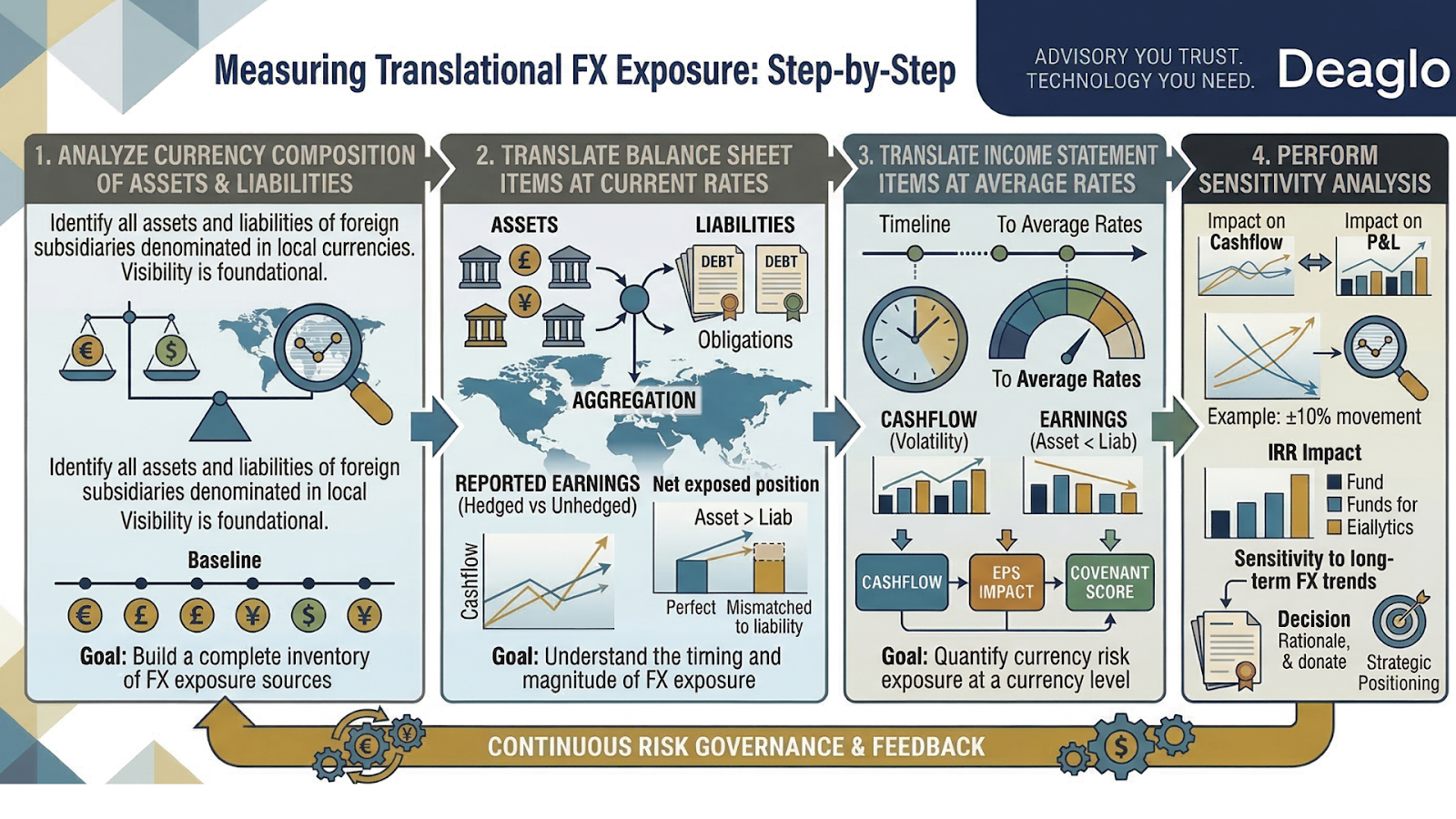
Guide to Measuring Translation Exposure
How to Manage Translational Exposure
Managing translational exposure is a key part of effective FX risk management, focusing on reducing volatility in reported financial statements rather than cash flows. Unlike transactional exposure, it is typically addressed through balance sheet strategies and accounting approaches.

Challenges in Managing Translational Exposure
Managing translational exposure can be complex, particularly for organizations with global operations and multi-entity structures.
Common Challenges
- Limited visibility across global entities
- Complex financial consolidation processes
- Volatility in reported financial results due to FX movements
- Difficulty separating operational performance from currency impact
The Role of Technology in FX Risk Management
Modern platforms play a critical role in improving how organizations manage translational exposure within broader FX risk management frameworks.
How Technology Enhances Translational Exposure Management
Platforms like Deaglo Intelligence enable:
- Centralized visibility across global entities
- Real-time analysis of FX impact on financial statements
- Scenario modeling for currency-driven valuation changes
- Consistent and audit-ready reporting frameworks
Organizations can better understand, monitor, and manage translational exposure alongside other FX risks.
Best Practices for Managing Translational Exposure
Managing translational exposure requires a structured approach that combines centralized financial data, continuous monitoring of currency positions, and scenario analysis to assess reporting impact. By aligning hedging strategies with reporting objectives and integrating FX risk management into financial processes, organizations can reduce volatility in reported earnings and improve financial transparency.
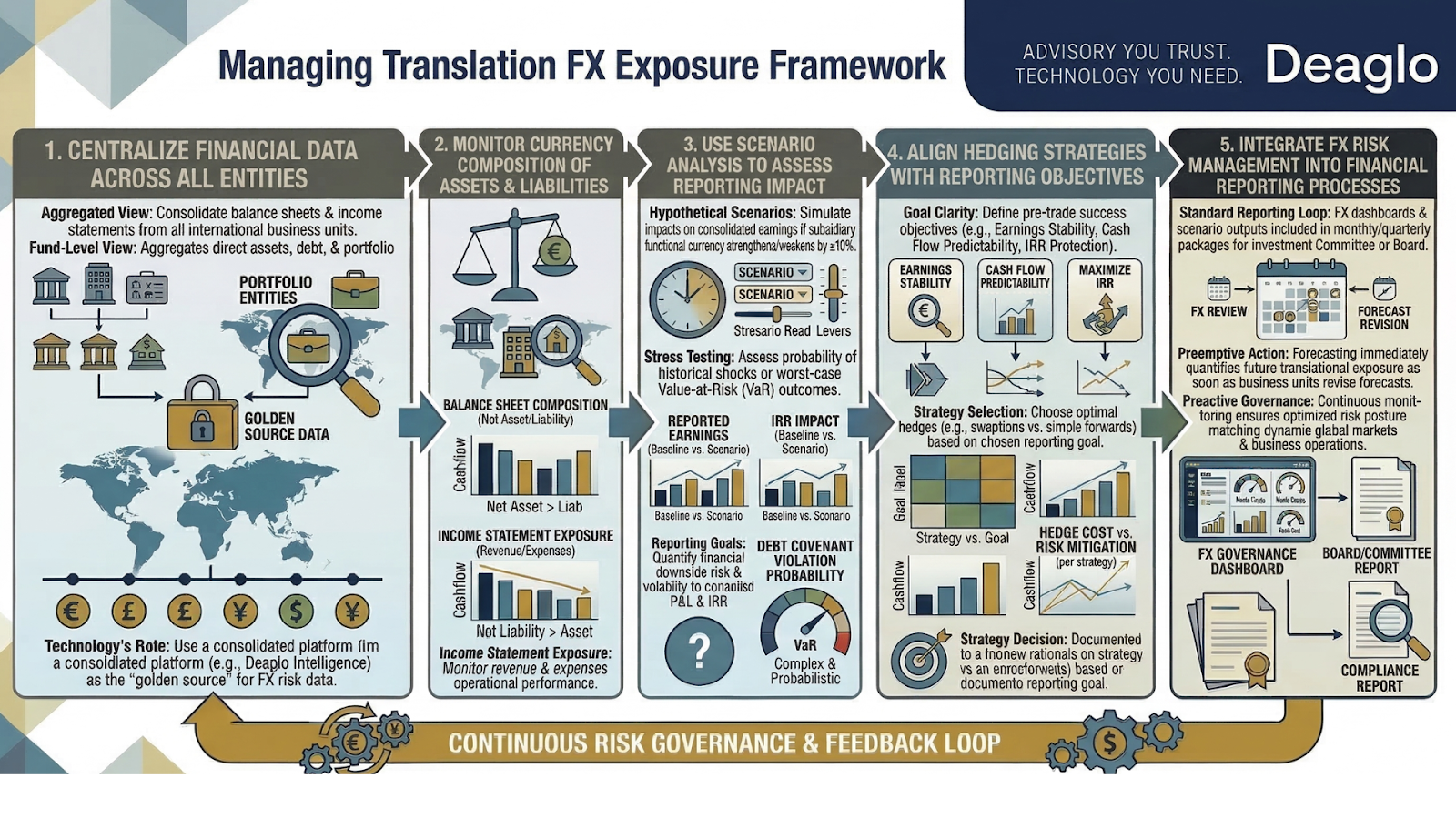
Key Takeaways
- Translational exposure affects reported financial statements, not cash flow
- It arises when foreign financials are converted into a reporting currency
- It impacts earnings, balance sheet valuations, and investor perception
- Managing translational exposure improves financial reporting stability
Conclusion
Translational exposure is a critical component of FX risk management, particularly for organizations with global operations. While it does not directly impact cash flow, its effect on financial reporting and investor perception makes it a key consideration for corporates and investment funds.
A structured approach to managing translational exposure ensures more accurate reporting, improved financial transparency, and better strategic decision-making.
Improve visibility across global financials Deaglo Intelligence helps you analyze and manage FX impacts across entities, ensuring more accurate reporting and better decision-making. Request a Demo: