The "Warsh Accord" and a New Era for the Fed
The nomination of Kevin Warsh to succeed Jerome Powell as Chair of the Federal Reserve (effective May 2026) marks a paradigm shift in U.S. monetary policy.
Warsh, a former Fed Governor and Wall Street veteran, is being viewed as a "market-friendly hawk"—one who aims to restore Fed credibility through an aggressive balance sheet reduction while simultaneously accommodating President Trump’s desire for lower front-end interest rates.
This suggests a steeper yield curve and a transition from the "predictable gradualism" of the Powell era to a more discretionary, results-oriented framework.
The Senate Confirmation Timeline: Q1–Q2 2026
While the Republican-controlled Senate Banking Committee (13-11 majority) favors a smooth path, the process is currently facing tactical delays.
- Current Status (Feb 2026): Democratic members, led by Sen. Mark Warner, have formally requested a delay in hearings until investigations into the Fed's building renovations and "pretextual" probes into Chair Powell and Governor Cook are resolved.
- Key Milestones:
- Early March 2026: Confirmation hearings are expected to begin under Chairman Tim Scott.
- April 2026: Committee vote and transition into full Senate floor debate.
- May 2026: Target date for swearing-in to coincide with the end of Jerome Powell’s term (May 23).
- The "Lame Duck" Risk: Markets are pricing in a period of "communication friction" between now and May. Jerome Powell remains the decision-maker, but Warsh’s testimony will likely become the de facto forward guidance for H2 2026.
Interest Rate Outlook: "Tapering Plus Rate Cuts"
Warsh’s proposed strategy is a departure from traditional central banking. He has advocated for a "New Accord" that balances two seemingly opposing forces:
- Front-Loaded Rate Cuts: Warsh argues that productivity gains from AI and deregulation allow for lower neutral rates. Expect an acceleration of rate cuts in H2 2026 to stimulate growth.
- Active Quantitative Tightening (QT): Unlike Powell’s passive runoff, Warsh favors active sales of Treasuries and MBS to shrink the "bloated" balance sheet.
- The Result: This "QT + Cuts" combo aims to lower short-term borrowing costs while keeping long-term inflation expectations anchored. However, it risks higher long-term yields and increased volatility in the Treasury market as the Fed’s footprint recedes.
Currency Market Implications
1. The US Dollar (USD): Short-Term Squeeze, Medium-Term Softening
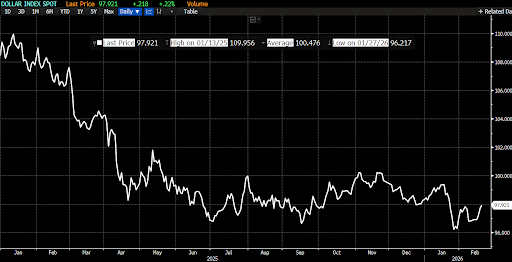
The immediate reaction to Warsh's nomination has been a USD rebound, as his "hawkish" reputation on the balance sheet provides a floor for the Greenback.
- The "Credibility Premium": If Warsh successfully asserts Fed independence while cleaning up the balance sheet, the USD could enjoy a "credibility bid."
- Medium-Term Outlook: As front-loaded rate cuts take hold in late 2026, the USD is expected to enter a volatile downward channel. If the yield spread between the USD and other G10 currencies narrows, capital may rotate out of over-concentrated US tech and into diversified global assets.
2. G10 Currencies: Divergent Paths
The G10 space will be defined by how other central banks react to the Fed’s new "discretionary" style.
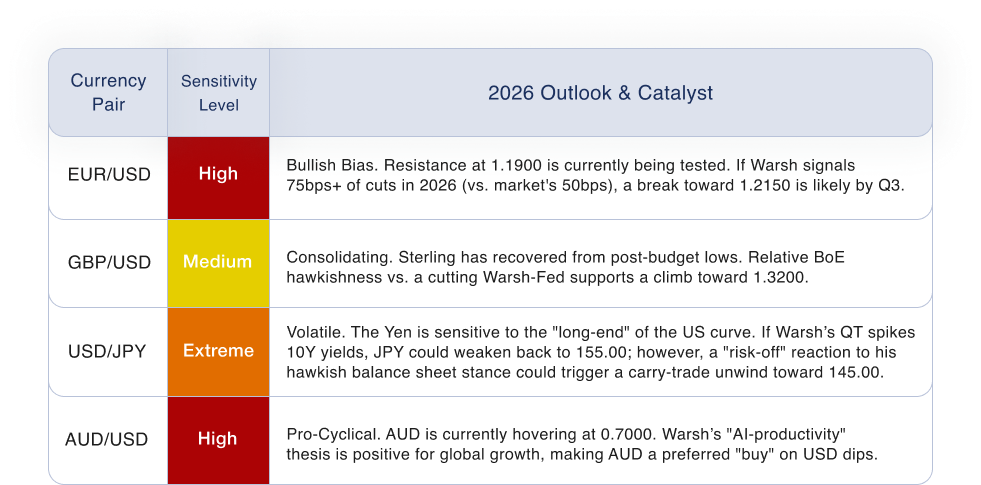
- EUR & GBP: Both the ECB and BoE remain in a "wait-and-see" mode. With the EUR/USD hovering near 1.19, a Warsh-led Fed that cuts faster than expected could see EUR/USD break above 1.20 by year-end, provided European growth remains resilient.
- JPY: The Yen has been the biggest beneficiary of the initial volatility. A steeper US curve (higher long-term yields) usually hurts the Yen, but if Warsh’s policies trigger a "risk-off" deleveraging in global markets, the JPY could see significant safe-haven inflows.
- CAD/AUD: These "commodity betas" will be sensitive to Warsh’s impact on global growth. If his "supply-side optimism" fuels a global recovery, expect CAD and AUD to outperform against the USD.
Summary: Navigating the "Warsh Regime"
The transition to a Kevin Warsh-led Federal Reserve in May 2026 represents the most significant departure from established monetary orthodoxy in over two decades. For global treasurers and fund managers, the takeaway is a shift from "slow and steady" to "strategic and volatile."
Warsh is expected to dismantle the "abundant reserves" framework of the Powell era. By aggressively shrinking the Fed's balance sheet (Active QT) while simultaneously cutting front-end rates, he aims to "normalize" the yield curve.
This policy duality—hawkish on the balance sheet, dovish on the policy rate—is designed to stimulate the real economy while restoring the Fed’s credibility as a price-stability hawk.
We are entering a data-heavy, guidance-light environment. With Warsh expected to retire the "Dot Plot" and move toward more opaque, discretionary signaling, market participants must pivot away from "Fed-watching" and back toward fundamental economic analysis.
Volatility is no longer a bug; in the Warsh regime, it is a feature of a market-driven Fed.