Short answer: for a USD fund, the IRR LPs receive is roughly the local-currency IRR reduced by the annual depreciation of the local currency. In an illustrative five-year Brazil deal, a 22% IRR in reais becomes about 16% in dollars at the last decade's average pace of depreciation, and about 14% at the pace today's forward curve implies.
Hedging can fix the exchange rate, but in high-carry markets the hedge costs roughly as much as the depreciation the forward curve already prices in. So the GP decision is less whether to hedge than what, where and when.
Why is local IRR not the IRR your LPs receive?
A portfolio company in São Paulo reports in reais, and your LPs are paid in dollars. The gap between the two is currency drag. In emerging markets it is often the largest single driver of the spread between the deal model and the distribution.
The approximation every GP should keep in mind:
(1 + USD IRR) ≈ (1 + local IRR) ÷ (1 + d)
Here d is the annualised depreciation of the local currency against the dollar over the hold. Brazil is the test case: the real combines high interest rates, deep derivatives markets and realised volatility of about 11% a year, so both the drag and the cost of removing it are large.
How much IRR can the currency take? A worked example
Illustrative example. Figures are simplified to show the mechanics. They are not a projection, a quote or the results of any Deaglo client.
A USD fund invests $50m into a Brazilian company at a spot rate of 5.18, which is R$258.9m. The business grows 22% a year in reais for five years and exits at R$699.7m. Only the exchange rate at exit changes.
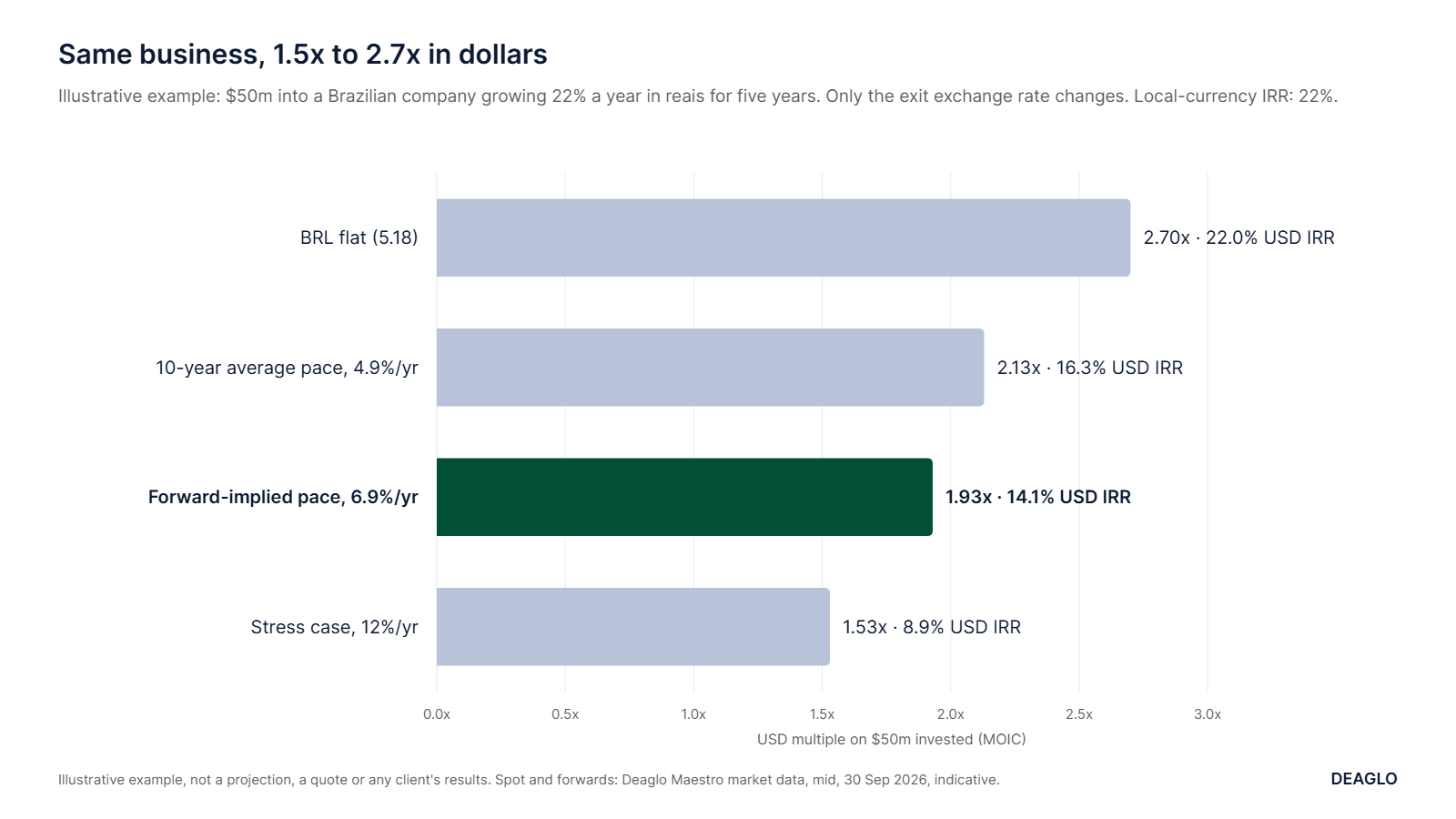
- BRL flat — Exit USD/BRL: 5.18; USD proceeds: $135.1m; USD MOIC: 2.70x; USD IRR: 22.0%
- 10-year average pace (4.9% a year) — Exit USD/BRL: 6.57; USD proceeds: $106.6m; USD MOIC: 2.13x; USD IRR: 16.3%
- Forward-implied pace (6.9% a year) — Exit USD/BRL: 7.24; USD proceeds: $96.6m; USD MOIC: 1.93x; USD IRR: 14.1%
- Stress case (12% a year) — Exit USD/BRL: 9.13; USD proceeds: $76.7m; USD MOIC: 1.53x; USD IRR: 8.9%
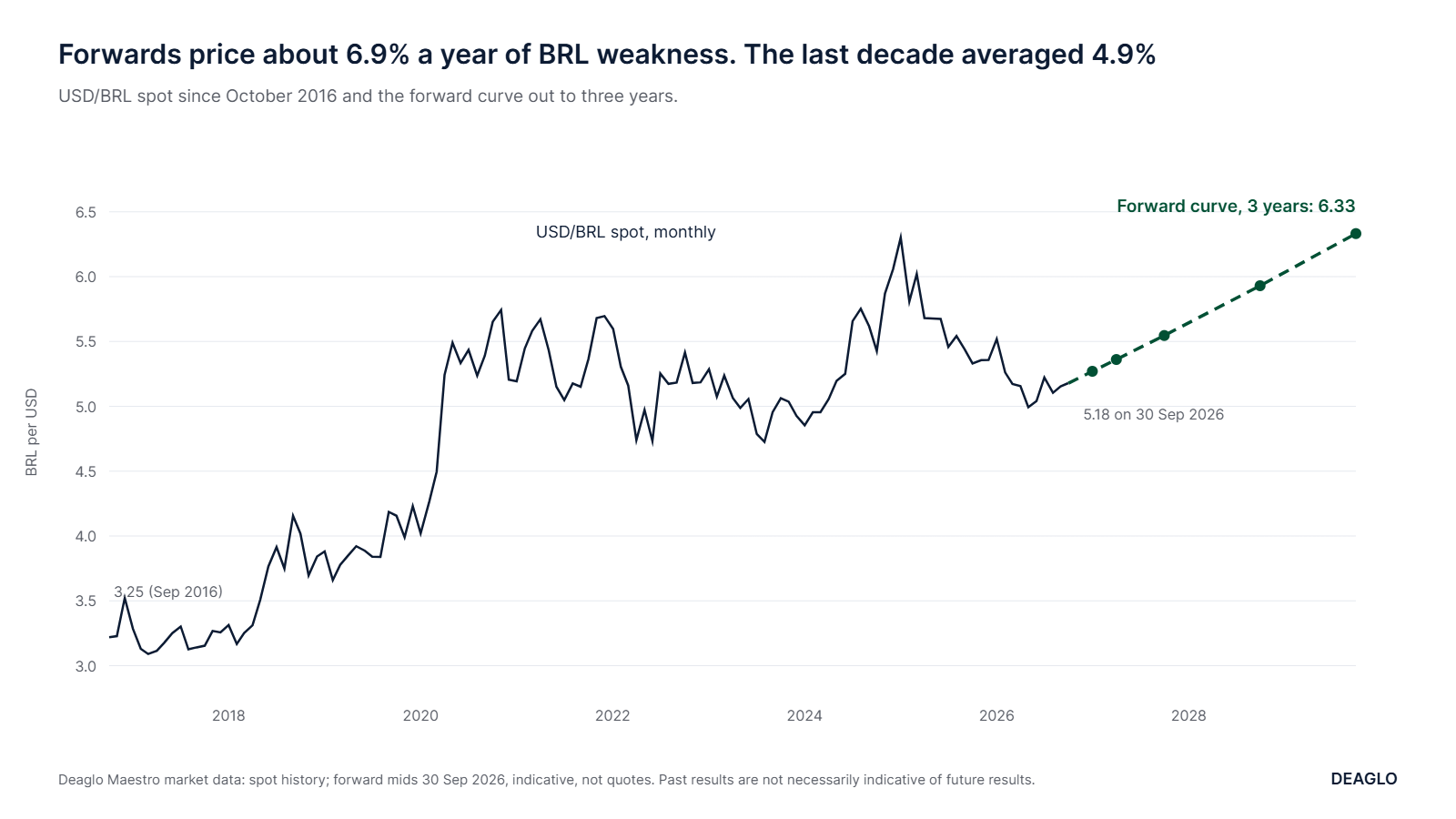
The same operating result produces anywhere from 1.5x to 2.7x in dollars. At the forward-implied pace, about eight points of IRR go to the currency. The 10-year pace reflects USD/BRL moving from 3.22 in October 2016 to 5.18 on 30 September 2026. Past results are not necessarily indicative of future results.
Why doesn't "just hedge it" restore the return in high-carry currencies?
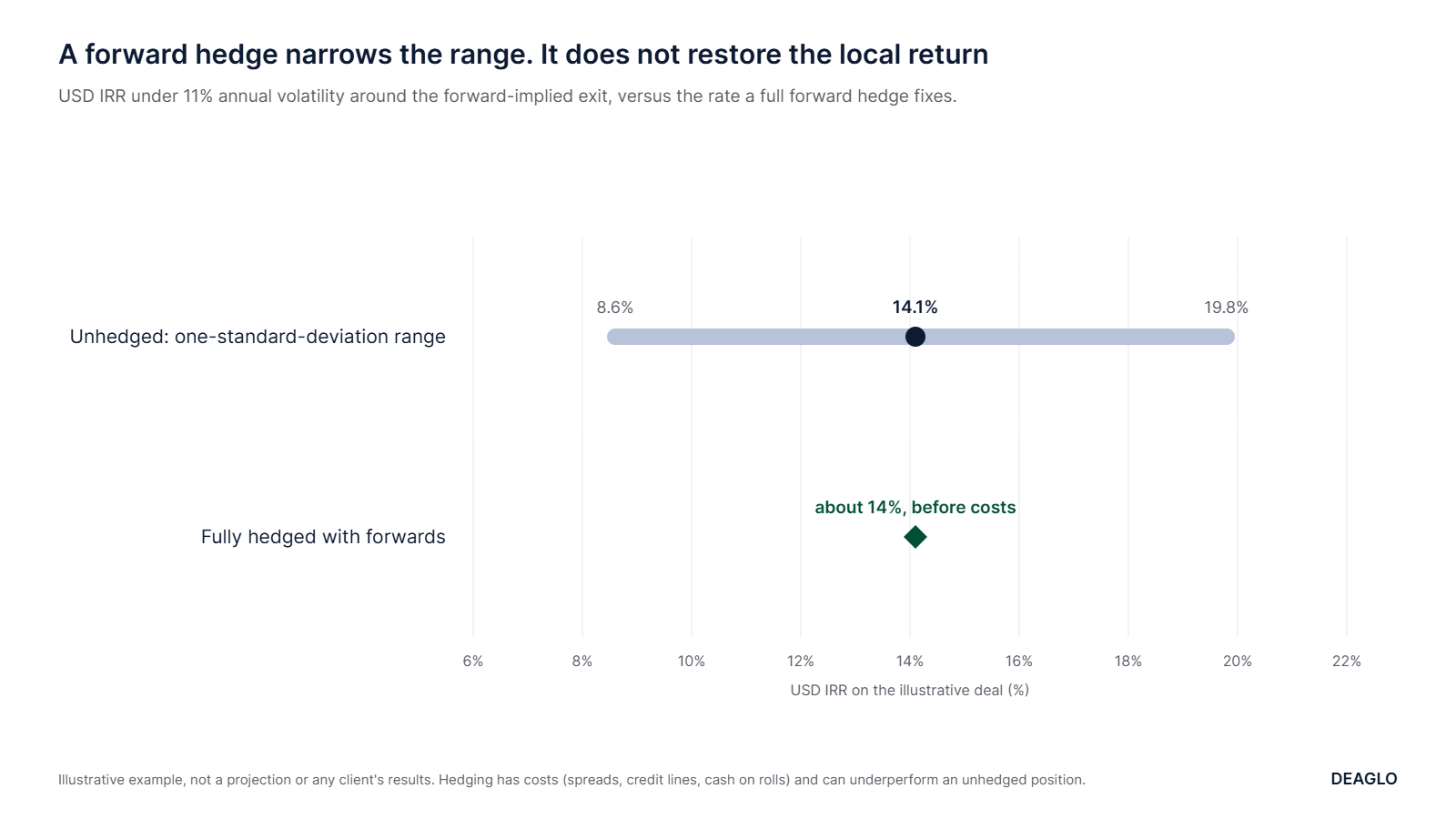
A full forward hedge does not restore the 22%. It fixes the forward-implied outcome, about 14% in the example, because the forward rate already prices the interest-rate gap between reais and dollars.
- The 1-year USD/BRL forward is 5.546 against spot of 5.178, an annualised carry cost of about 7.1%.
- The 3-year forward is 6.332, about 6.9% a year.
- Realised BRL depreciation over the last 10 years averaged about 4.9% a year, below today's carry. Past results are not necessarily indicative of future results.
Over that decade, the forward points on a fully hedged position cost more than the currency actually moved, on average. What a hedge buys is a narrower range of outcomes, not a higher expected return. With 11% annual volatility, a one-standard-deviation move over five years shifts the exit rate by about 28%. In the example, that is the difference between roughly 9% and 20% USD IRR around the forward case.
Hedging carries its own costs and risks, and a hedged position can end up worse than an unhedged one. Three matter as much as the carry:
- Cash on rolls. Rolling 3- or 12-month forwards settles mark-to-market in cash at every roll. If BRL strengthens, the fund must fund the hedge loss, often from the subscription line.
- Credit lines. Bank credit lines for a closed-end fund are finite. Long-dated hedges use capacity the next deal may need.
- Option premiums. Buying options caps the downside, and the maximum loss on a bought option is the premium plus costs. The premium is paid up front and is lost if the option expires unused. Selling options to reduce that cost brings margin calls and potentially unlimited losses.
What should a GP decide about currency risk?
In our view, currency is best treated as a risk budget rather than a yes-or-no question. Four decisions, taken at investment committee and reviewed each year:
- 1. What to hedge — Options: Invested capital, interim cash (dividends, coupons), exit proceeds; How to choose: Start with what is near and known: distributions in the next 12 to 18 months and a signed or likely exit. Long-dated capital can sit inside a policy band.
- 2. Where the hedge sits — Options: Fund level or deal level; How to choose: Fund-level hedges address LP-level currency exposure but use the fund's credit lines and cash. Deal-level hedges fit the investment's cash flows.
- 3. Instrument — Options: Forwards, NDFs and options; How to choose: Forwards fix the rate at the carry cost. Bought options limit the maximum loss to the premium and costs while leaving the position open to currency moves.
- 4. Tenor and layering — Options: Rolling short-dated, matched to hold, layered; How to choose: Layer by horizon, for example a higher ratio on 12-month flows, a lower ratio on 12 to 24 months and a band on the rest, rebalanced quarterly.
A useful test for any programme: does it keep the fund's USD outcome within the range the fund has communicated to LPs, at a cost the GP can explain? A hedge can do that and still lose money in a given year.
What should GPs report to LPs on currency?
LPs increasingly ask for currency attribution, not just a headline USD IRR. Three numbers per EM position each quarter make it clear:
- Local-currency IRR: how the business performed.
- FX contribution: the USD IRR minus the local IRR, before hedging.
- Hedge contribution: the P&L of the hedge programme, including carry paid.
Together they show whether the result came from the business, the currency or the hedging decision. Pair them with a one-page FX policy that states what the fund hedges, the ratios, the instruments and who approves exceptions. In our experience, sophisticated LPs ask for that policy early in due diligence.
Deaglo works with GPs to measure currency exposure across a portfolio and model hedged and unhedged outcomes under current market data. Learn how Deaglo approaches FX risk management.
About the author
Ashley Groves is CEO and Founder of Deaglo, an FX and interest rate risk advisory firm with offices in New York, São Paulo and Mexico City. She has spent more than 15 years in institutional FX, including a decade at AFEX as Director of Managed FX. Deaglo advises GPs, LPs, private credit funds, portfolio companies and corporates on managing currency and interest rate risk.
Methods. USD/BRL spot (5.178) and forwards (1-year 5.546, 2-year 5.930, 3-year 6.332) are mid rates from Deaglo's Maestro market data as of 30 September 2026. Annualised volatility (11.0%) is realised over the trailing year of daily spot rates. Historical spot is from the same source. The forward-implied path extends the 3-year annualised rate to five years. All figures are indicative and are not quotes.
This article is for general information and education only. It is not investment, legal, tax or accounting advice, and it is not a recommendation or solicitation to enter into any transaction. Trading foreign exchange, forwards, options and other derivatives involves substantial risk of loss and is not suitable for every person. Hedging reduces some risks but has costs, and a hedged position can perform worse than an unhedged one. Opinions are Deaglo's as of the publication date and may change. Prices and market data are indicative as of the time shown and are not quotes.