Economic FX Exposure Explained: Impact, Examples & Management Strategies
In a global financial environment where capital, operations, and investments span multiple currencies, exchange rate movements can have a profound impact on long-term performance. While many organizations focus on short-term FX risks, the more significant challenge often lies in economic FX exposure, the structural effect of currency fluctuations on future cash flows, competitiveness, and valuation.
For corporates and investment funds, economic FX exposure is not just a financial risk, it is a strategic variable that influences pricing, margins, investment returns, and market positioning. Understanding and managing this exposure is essential for making informed, forward-looking decisions in cross-border environments.
.png)
What Is Economic FX Exposure?
Economic FX exposure (also known as operating exposure) refers to the long-term impact of currency fluctuations on a company’s or investment’s future cash flows, competitiveness, and valuation.
Unlike transactional or translational exposure, economic FX exposure is strategic and forward-looking. It affects:
- Revenue growth
- Cost structures
- Market competitiveness
- Investment returns
- Enterprise valuation
Why Economic FX Exposure Matters for Corporates and Funds
For Corporates
Corporates operating across borders face economic FX exposure, a structural currency risk that extends beyond transactional invoices and financial reporting. This type of exposure directly impacts pricing, competitiveness, and long-term profitability in global markets.
Example: US Manufacturer Competing in Europe
A US-based manufacturer generates a significant portion of its revenue from international markets and competes directly with European firms.
- The company produces goods in the US (costs in USD)
- It sells globally, including Europe, where competitors operate with cost bases in EUR
If the EUR weakens against the USD:
- European competitors can reduce export prices while maintaining margins
- The US company must either:
- Lower prices → compressing margins, or
- Maintain pricing → losing market share
- Lower prices → compressing margins, or
Over time, this creates structural pressure:
- Reduced demand in key markets
- Declining revenue growth in foreign regions
- Margin erosion due to pricing adjustments
- Strategic disadvantage in global tenders or contracts
Impact: Economic FX exposure leads to loss of competitiveness, margin compression, weaker demand, and long-term profitability decline, even when underlying operations remain stable.
For Investment Funds
Investment funds deploying capital across borders face economic FX exposure, where currency movements directly affect asset-level performance, valuation, and realized returns. Unlike transactional FX risk, this exposure impacts the true economic outcome of an investment over its lifecycle.
Example: Private Equity Investment in Mexico
A US-based private equity fund invests in a Mexican company:
- Investment and operations are in MXN (Mexican Peso)
- Fund reporting and investor returns are in USD
- The asset generates stable and growing local EBITDA in MXN
If the MXN depreciates against the USD during the investment period:
- The company continues to perform well operationally
- EBITDA grows in MXN terms
However, when converted to USD:
- Revenue and EBITDA translate into lower USD values
- Exit valuation (in USD terms) declines
At exit:
- Strong local performance does not translate into equivalent USD returns
- The fund realizes lower proceeds than expected when repatriating capital
Over time, this creates structural impact:
- Reduced IRR despite solid asset performance
- Misalignment between operational success and reported returns
- Increased volatility in portfolio-level performance
- Pressure on fund benchmarks and investor expectations
Impact: Economic FX exposure results in lower IRR, distorted performance metrics, and reduced investor returns, even when the underlying investment performs strongly in local currency terms.
Types of Economic FX Exposure
Economic FX exposure is not a single risk, it manifests across multiple dimensions of a business or investment. From revenues and costs to competitive positioning and asset-level returns, currency movements can influence different parts of the value chain in distinct ways. Understanding these types of economic exposure helps corporates and funds identify where risk exists and apply targeted FX risk management strategies.

Economic vs Transactional vs Translational Exposure
Foreign exchange exposure can be categorized into three main types: transactional, translational, and economic FX exposure. While transactional exposure affects short-term cash flows and translational exposure impacts financial reporting, economic FX exposure is the most strategic, influencing long-term business performance, competitiveness, and investment returns.

How to Measure Economic FX Exposure
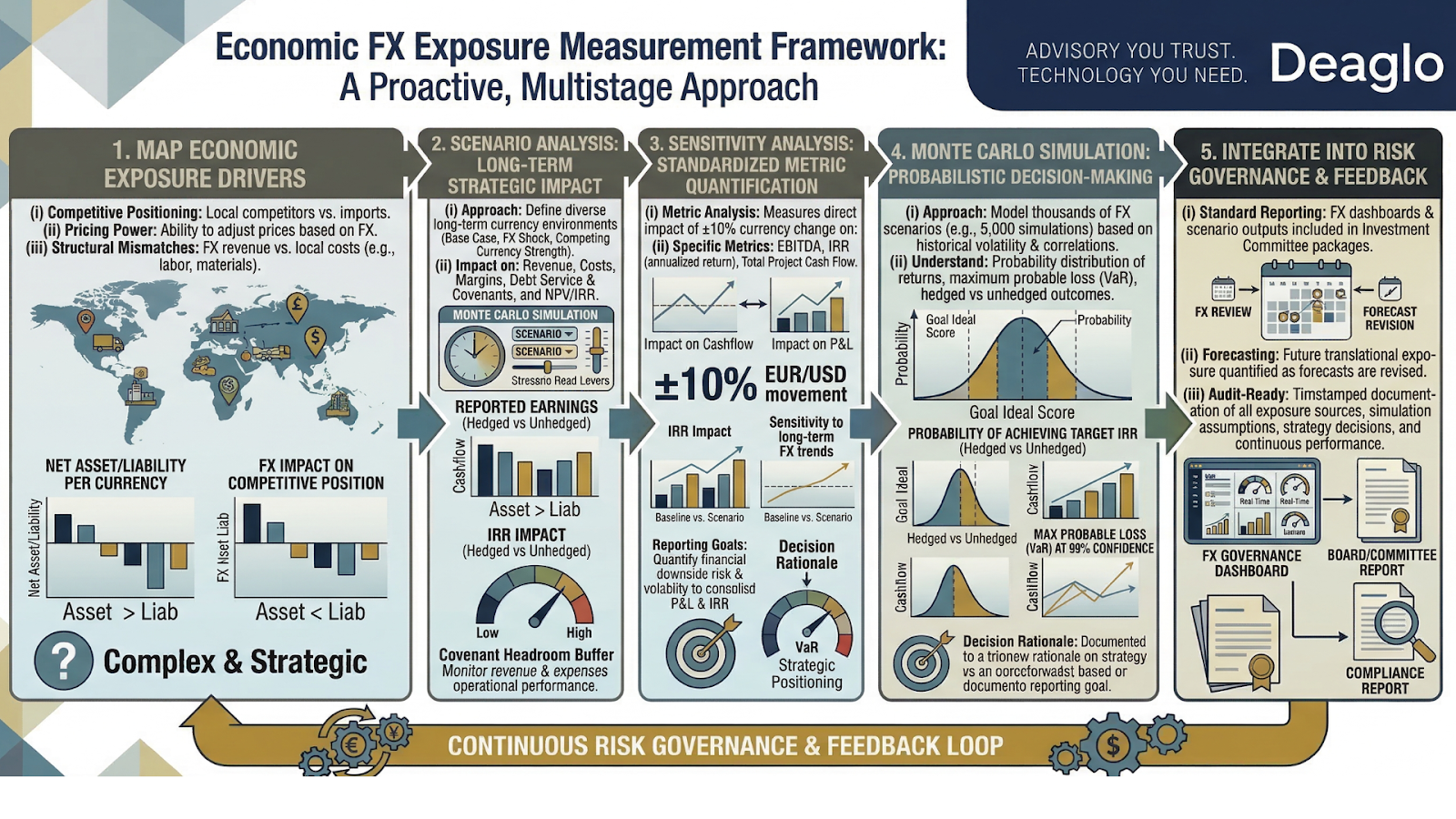
Economic FX exposure cannot be directly observed, it must be measured using forward-looking models. Corporates and investment funds operating in global markets rely on scenario analysis, sensitivity analysis, and Monte Carlo simulation to understand how exchange rate movements impact cash flows, margins, valuations, and investment returns.
By evaluating a range of currency scenarios, organizations can identify downside risk, quantify uncertainty, and assess potential outcomes across different market environments.
For global corporates and cross-border investors, this approach transforms FX risk management from static reporting into forward-looking decision-making, enabling more informed strategies, improved financial planning, and stronger performance in volatile currency markets.
Real-World Examples of Economic FX Exposure
Economic FX exposure is best understood through practical corporate and investment scenarios, where currency movements directly impact revenues, valuations, and returns across global markets.
Corporate Example: Revenue Impact from EUR/USD Movements
A US-based company generates €50 million in annual revenue from Europe, while reporting in USD.
- At an exchange rate of 1 EUR = 1.10 USD, revenue equals $55 million
- If the euro depreciates to parity (1 EUR = 1.00 USD), revenue falls to $50 million
Impact of Economic FX Exposure:
- $5 million revenue decline (~9%) purely due to currency movement
- Operating performance remains unchanged, but reported revenue decreases
- Margins compress as costs remain largely USD-based
Key Insight: Even without changes in sales volume or pricing, currency fluctuations can materially reduce revenue and profitability, highlighting the strategic importance of economic FX exposure for corporates operating internationally.
Investment Fund Example: FX Impact on Returns and IRR
A private equity fund invests BRL 100 million in a Brazilian asset, with returns measured in USD.
- Initial exchange rate: 1 USD = 5 BRL → Investment value = $20 million
- At exit, the asset grows to BRL 130 million
If exchange rates remained stable:
- Exit value = $26 million equivalent
However, if the Brazilian Real depreciates to 1 USD = 6 BRL:
- Exit value converts to approximately $21.7 million
Impact of Economic FX Exposure:
- Significant reduction in USD returns despite strong local performance
- IRR declines purely due to currency depreciation
- Misalignment between asset-level success and investor outcomes
Key Insight: For global investors, economic FX exposure can erode returns and distort performance metrics, making FX risk management critical to achieving target investment outcomes.
Strategies to Manage Economic FX Exposure
Managing economic FX exposure requires more than traditional hedging, it demands a strategic, integrated approach across operations, finance, and decision-making. Because this type of exposure is driven by uncertain future cash flows and long-term market dynamics, it cannot be fully eliminated through financial instruments alone.
Corporates and investment funds operating in global markets must combine operational alignment, financial hedging, diversification, and scenario-based analytics to effectively manage currency risk. This approach enables organizations to protect margins, stabilize returns, and maintain competitiveness across different currency environments.

The Role of Technology in Managing Economic FX Exposure
Modern FX risk management requires more than static reports and spreadsheets. Managing economic FX exposure effectively depends on real-time visibility and forward-looking analytics that allow organizations to understand how currency movements impact performance before decisions are made.
Technology enables corporates and investment funds to move from reactive FX management to a structured, data-driven approach. Key capabilities include:
- Centralized exposure tracking across entities, portfolios, and currencies
- Scenario simulation to assess the impact of FX movements on cash flow, margins, and IRR
- Real-time mark-to-market visibility for accurate performance monitoring
- Strategy evaluation and comparison across hedged and unhedged scenarios
- Automated reporting to support governance, compliance, and internal decision-making
Deaglo Intelligence: Managing Economic FX Exposure
Deaglo Intelligence provides a unified platform for corporates and investment funds to quantify, simulate, and manage economic FX exposure across their operations and investments.
With Deaglo Intelligence, organizations can:
- Quantify economic FX exposure across portfolios, entities, and currency pairs
- Simulate the impact of currency movements on:
- Internal Rate of Return (IRR)
- Cash flows
- Operating margins
- Internal Rate of Return (IRR)
- Compare hedging strategies using real pricing logic, not static assumptions
- Replace fragmented spreadsheets and tools with a single, integrated intelligence layer
Organizations move from reactive FX management to defensible, data-driven decision-making, enabling stronger financial performance and more confident cross-border strategies.
Best Practices for Managing Economic FX Exposure
Effectively managing economic FX exposure requires a structured and forward-looking approach that integrates currency risk into core business and investment decisions. For corporates and investment funds operating in global markets, best practices include:
- Integrating FX risk into strategic planning to align currency considerations with long-term objectives
- Using scenario analysis and modeling to forecast the impact of exchange rate movements on cash flows and returns
- Aligning hedging strategies with business goals, focusing on value protection rather than just volatility reduction
- Continuously monitoring exposure across entities, portfolios, and currencies
- Leveraging technology platforms to ensure consistency, scalability, and data-driven decision-making
The Future of Economic FX Exposure Management
As global markets become more interconnected and capital flows increase, economic FX exposure will play an even greater role in financial performance.
- Currency volatility will remain a key driver of returns and risk
- Corporates and investors will demand decision intelligence, not just reporting
- Static hedging approaches will evolve into dynamic, model-driven strategies powered by analytics
Economic FX exposure is no longer just a finance function, it is a core strategic lever that shapes competitiveness, valuation, and investment outcomes.
Conclusion
Economic FX exposure is one of the most critical yet often overlooked risks in global finance. It extends beyond short-term currency movements, influencing long-term value creation, profitability, and investment performance.
Corporates and investment funds that adopt structured, data-driven FX risk management frameworks will be better positioned to:
- Protect margins in volatile currency environments
- Stabilize returns across global portfolios
- Make confident cross-border decisions backed by analytics and scenario modeling
Turn FX Exposure into Strategic Advantage - Deaglo Intelligence helps you quantify, simulate, and manage economic FX exposure across your business or portfolio. Request a Demo.