Short answer: currency can decide a non-USD fund's dollar outcome. Over the ten years to 30 September 2026 the Brazilian real lost about 4.5% a year against the dollar; on that path, an illustrative 15% local IRR becomes roughly 9.8% in USD.
LPs can ask every non-USD GP for three things: a written hedging policy, attribution that splits local, FX and hedge returns, and the all-in cost of any hedge. Figures are indicative. Past results are not necessarily indicative of future results.
Why does a reported USD IRR mix three different things?
A USD IRR on a non-USD fund blends three sources of return: the local performance of the assets, the currency move between call and distribution, and the result of any hedge the GP ran.
Only the first is the manager's core skill. The second is a macro exposure the LP may or may not want. The third is a policy choice with its own cost and cash needs.
Ignoring the hedge, a rule of thumb links local and USD returns, where d is the annual appreciation of USD against the fund currency:
(1 + USD IRR) ≈ (1 + local IRR) ÷ (1 + d)
Illustrative example. Figures are simplified to show the mechanics. They are not a projection or the results of any fund or Deaglo client.
USD/BRL moved from 3.25 on 30 September 2016 to 5.18 on 30 September 2026, a d of about 4.8% a year. A 15% local IRR therefore compounds to about 9.8% in USD, roughly 5.2 points a year lost to currency.
The window matters as much as the currency. Over the five years from 30 September 2021, USD/BRL fell from 5.44 to 5.18, so a fund of that vintage gained about 1.2 points a year from the real. Same currency, opposite sign, different vintage.
How much of reported IRR in emerging market funds is lost to currency moves?
Over ten years the range ran from about 4.5% a year lost in BRL to 0.7% a year gained in MXN. Five-year figures show how much the vintage changes the picture.
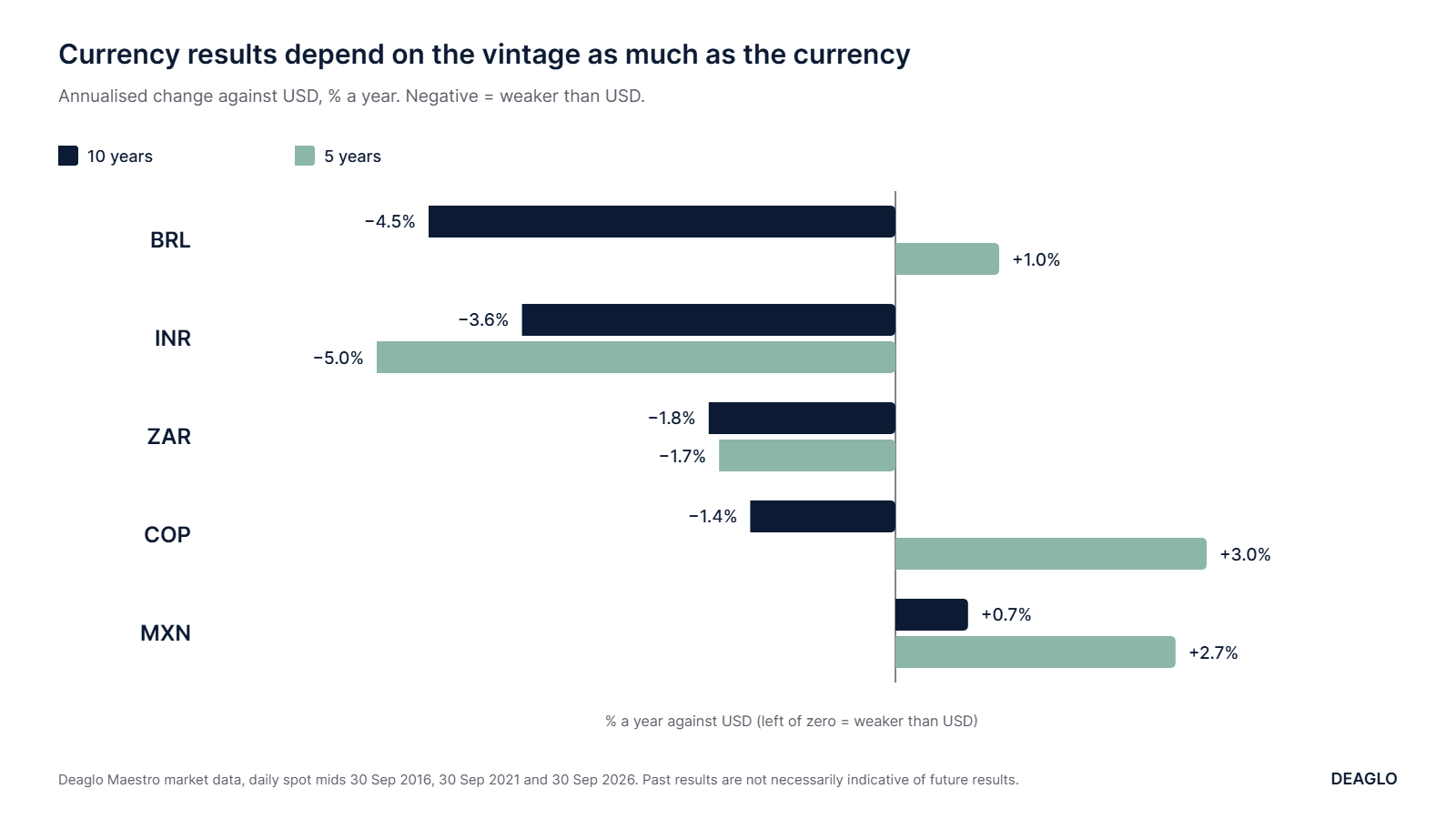
- BRL: 10 years to 30 Sep 2026: −4.5; 5 years to 30 Sep 2026: +1.0
- INR: 10 years to 30 Sep 2026: −3.6; 5 years to 30 Sep 2026: −5.0
- ZAR: 10 years to 30 Sep 2026: −1.8; 5 years to 30 Sep 2026: −1.7
- COP: 10 years to 30 Sep 2026: −1.4; 5 years to 30 Sep 2026: +3.0
- MXN: 10 years to 30 Sep 2026: +0.7; 5 years to 30 Sep 2026: +2.7
Four of the five currencies lost ground over ten years. Over five years BRL, COP and MXN gained, while ZAR and INR lost. A GP's currency result is as much a vintage effect as a policy outcome. Past results are not necessarily indicative of future results.
What should LPs ask GPs about currency hedging policy?
These twelve questions fit into an operational due diligence questionnaire or an annual review. Each has a note on what a strong answer usually includes.
Policy and governance
- Do you have a written FX hedging policy, and who approved it? A strong answer: a board- or IC-approved document with objectives, hedge ratios, tenors and review dates.
- Who makes hedging decisions, and how are they documented? A named committee or CFO, dated minutes, and a clear line between policy and discretion.
- What would make you change the hedge ratio mid-life? Pre-set triggers, such as exit visibility or collateral headroom, rather than market views.
What is hedged, and where
- Which exposures are hedged: fund-level NAV, asset-level cash flows or fund-level debt? A map by layer, showing where currency sits and which layer carries each hedge.
- What share of expected exit value is hedged today, and for what tenor? A current ratio, a target range and a maturity ladder tied to the exit plan.
- How do you treat subscription line and NAV facility drawings in other currencies? Facility currency matched to assets or hedged, with any mismatch quantified.
Instruments, counterparties and collateral
- Which instruments do you use: forwards, NDFs, options, collars or cross-currency swaps? A short list matched to the exposure, with a reason for any option premium spent and an explanation of any sold options and their risks.
- Who are your counterparties, and on what documentation? Several ISDA counterparties, known CSA terms and no single-bank dependency.
- How do you fund margin calls, and what stress have you run? A stated liquidity source and a tested adverse move, sized against realised volatility.
Reporting and attribution
- Do you report local IRR, FX contribution and hedge contribution each quarter? All three, reconciling to the USD IRR at fund and deal level.
- How are hedge gains, losses and roll costs treated in the waterfall and carry? An explicit LPA or side-letter treatment, so carry is not earned on unmanaged currency moves.
Cost
- What did hedging cost last year, all in? Forward points, spreads, option premium and advisory fees in basis points of NAV, benchmarked against market mid.
What are the red flags?
- "We don't hedge because currencies mean-revert": Why it matters: BRL, INR, ZAR and COP were all weaker against USD after ten years, not back where they started.
- No written policy, or a policy nobody can produce: Why it matters: Decisions become ad hoc and change with the market or the CFO.
- Only USD IRR is reported: Why it matters: The LP cannot separate manager performance from currency moves.
- Hedge P&L buried in "other" or fund expenses: Why it matters: Losses and roll costs hide inside the net return.
- One bank provides every hedge: Why it matters: Credit lines, pricing and collateral terms all depend on one relationship.
- No margin stress test: Why it matters: A sharp USD rally can force asset sales or subscription line draws to meet calls.
- Carry paid on unhedged FX gains: Why it matters: The GP is rewarded for a macro move it did not manage.
- Hedge tenor far shorter than the hold, with no roll plan: Why it matters: Roll costs and cash settlements can arrive at the worst time.
- Hedge cost quoted without a market benchmark: Why it matters: Bank spreads on EM forwards can take a visible share of the carry.
Should LPs hedge capital calls to non-USD funds?
Many LPs hedge committed calls with a known window, and few hedge the whole commitment. The LP holds exposures the GP never sees, and those are the LP's to manage.
- Commitments to non-USD funds. A EUR or BRL commitment is a short-currency liability until it is called. Undrawn commitments swing in USD terms and can breach allocation bands. Many LPs hedge a rolling share of expected calls over the next 12 to 18 months.
- Capital call and distribution FX. Each call and distribution is a spot conversion, often at a custodian's standing rate. Pooling conversions, pre-hedging notified calls and benchmarking execution against mid can reduce execution costs.
- Portfolio-level overlays. An LP with several funds in one currency can net calls against distributions, then hedge the net exposure once, with one set of counterparties and one collateral pool.
The main cost of hedging is carry, and in high-yield currencies it is large. On 30 September 2026 the one-year forward-implied cost of selling each currency forward against USD was:
- COP: Spot (per USD): 3,310.64; 1-year forward (per USD): 3,585.89; 1-year forward-implied carry: 8.3%; Realised 1-year vol: 14.9%
- BRL: Spot (per USD): 5.1780; 1-year forward (per USD): 5.5456; 1-year forward-implied carry: 7.1%; Realised 1-year vol: 11.0%
- INR: Spot (per USD): 95.970; 1-year forward (per USD): 99.125; 1-year forward-implied carry: 3.3%; Realised 1-year vol: 6.4%
- MXN: Spot (per USD): 18.0672; 1-year forward (per USD): 18.4844; 1-year forward-implied carry: 2.3%; Realised 1-year vol: 7.9%
- ZAR: Spot (per USD): 16.4205; 1-year forward (per USD): 16.7483; 1-year forward-implied carry: 2.0%; Realised 1-year vol: 13.0%
- EUR: Spot (per USD): 0.8819; 1-year forward (per USD): 0.8666; 1-year forward-implied carry: −1.7% (a pickup for a USD investor); Realised 1-year vol: 5.3%
Indicative mid rates, Deaglo Maestro market data, 30 September 2026. Not quotes.
The 7.1% BRL carry on 30 September was higher than the real's average depreciation over the previous ten years, about 4.8% a year. Put another way, carry at that level exceeded the average annual move the real actually made over that decade. Past results are not necessarily indicative of future results. That is why hedge ratio and tenor tend to matter more than the yes-or-no question.
When does LP-level hedging fit better than GP-level hedging?
- The LP holds several funds in the same currency and can net flows.
- The LP wants a uniform hedge ratio across managers, not twelve different policies.
- The LP has better credit terms, ISDA coverage or collateral than a single fund.
- The exposure is the commitment or the call timing, which the GP cannot see.
- The LP's liability currency differs from the fund's USD share class.
GP-level hedging usually fits asset-level cash flows better: a known exit, a local-currency loan or a portfolio company's dollar debt.
What does good currency reporting look like?
Good reporting lets an LP rebuild the USD IRR from its parts every quarter, with three lines that add up:
- Local IRR: the return of the assets in fund or deal currency, since inception and for the quarter.
- FX contribution: the effect of the spot move on unhedged exposure, in points of IRR.
- Hedge contribution: realised and unrealised hedge P&L net of roll costs and premium, in points of IRR.
The same split can appear at deal level for the largest positions, with the hedge ratio, the tenor ladder and collateral posted at quarter end. A one-page policy summary belongs in the annual report, with any changes flagged.
Deaglo works with LPs to review GP hedging policies and attribute FX in fund returns. Learn how Deaglo approaches FX risk management.
About the author
Ashley Groves is CEO and Founder of Deaglo, an FX and interest rate risk advisory firm with offices in New York, São Paulo and Mexico City. He has spent more than 15 years in institutional FX, including a decade at AFEX as Director of Managed FX. Deaglo advises GPs, LPs, private credit funds, portfolio companies and corporates on managing currency and interest rate risk.
Methods. Deaglo Maestro market data, indicative mid rates, not quotes. Historical spot: daily mids for 30 September 2016 and 30 September 2021. Current spot, 52-week forwards and realised volatility (trailing year of daily spot, annualised over 251 sessions) as of 30 September 2026. Annualised currency change vs USD is (spot then ÷ spot now)^(1/years) − 1; USD appreciation d is (spot now ÷ spot then)^(1/years) − 1. One-year carry is the 52-week forward mid ÷ spot mid − 1, before spreads. The IRR example applies the rule of thumb above and ignores hedging and cash-flow timing.
This article is for general information and education only. It is not investment, legal, tax or accounting advice, and it is not a recommendation or solicitation to enter into any transaction. Trading foreign exchange, forwards, options and other derivatives involves substantial risk of loss and is not suitable for every person. Hedging reduces some risks but has costs, and a hedged position can perform worse than an unhedged one. Opinions are Deaglo's as of the publication date and may change. Prices and market data are indicative as of the time shown and are not quotes.