Short answer: a USD private credit fund that lends in BRL, MXN or COP and hedges keeps roughly the local coupon minus the forward-implied carry, plus or minus cross-currency basis. On 12 October 2026 the indicative 3-year carry was about 6.0% a year for USD/BRL, 3.2% for USD/MXN and 8.5% for USD/COP.
In an illustrative case, an 18% BRL loan hedged with a matched forward strip yields about 11.4% in USD. Funds typically hedge with non-deliverable forwards (NDFs) matched to the amortisation schedule, or with a cross-currency swap when tenor and credit lines allow.
Why does the hedge cost eat most of the local coupon?
The local coupon is high because local interest rates are high. The forward points that price the hedge reflect the same rate differential, so a fully hedged lender gives most of the headline yield back to the forward curve.
The working rule: hedged USD yield ≈ local coupon − annualised carry (± cross-currency basis). What survives the hedge is broadly the credit spread over the local rate, not the local rate itself.
- USD/BRL — Spot (mid): 4.9905; 1-year forward (mid): 5.3122; 3-year forward (mid): 5.8886; 1-year carry, % a year: 6.45; 3-year carry, % a year: 6.00; Realised vol, 1 year: 11.0%
- USD/MXN — Spot (mid): 18.3294; 1-year forward (mid): 18.7871; 3-year forward (mid): 20.1070; 1-year carry, % a year: 2.50; 3-year carry, % a year: 3.23; Realised vol, 1 year: 8.0%
- USD/COP — Spot (mid): 3,180.52; 1-year forward (mid): 3,438.39; 3-year forward (mid): 3,994.69; 1-year carry, % a year: 8.11; 3-year carry, % a year: 8.53; Realised vol, 1 year: 14.8%
Indicative, not quotes. Deaglo Maestro market data, mid rates as of 12 October 2026. 1-year = 12 months, 3-year = 36 months. Carry is simple annualised: (forward ÷ spot − 1) ÷ years. Realised volatility is trailing one-year, annualised.
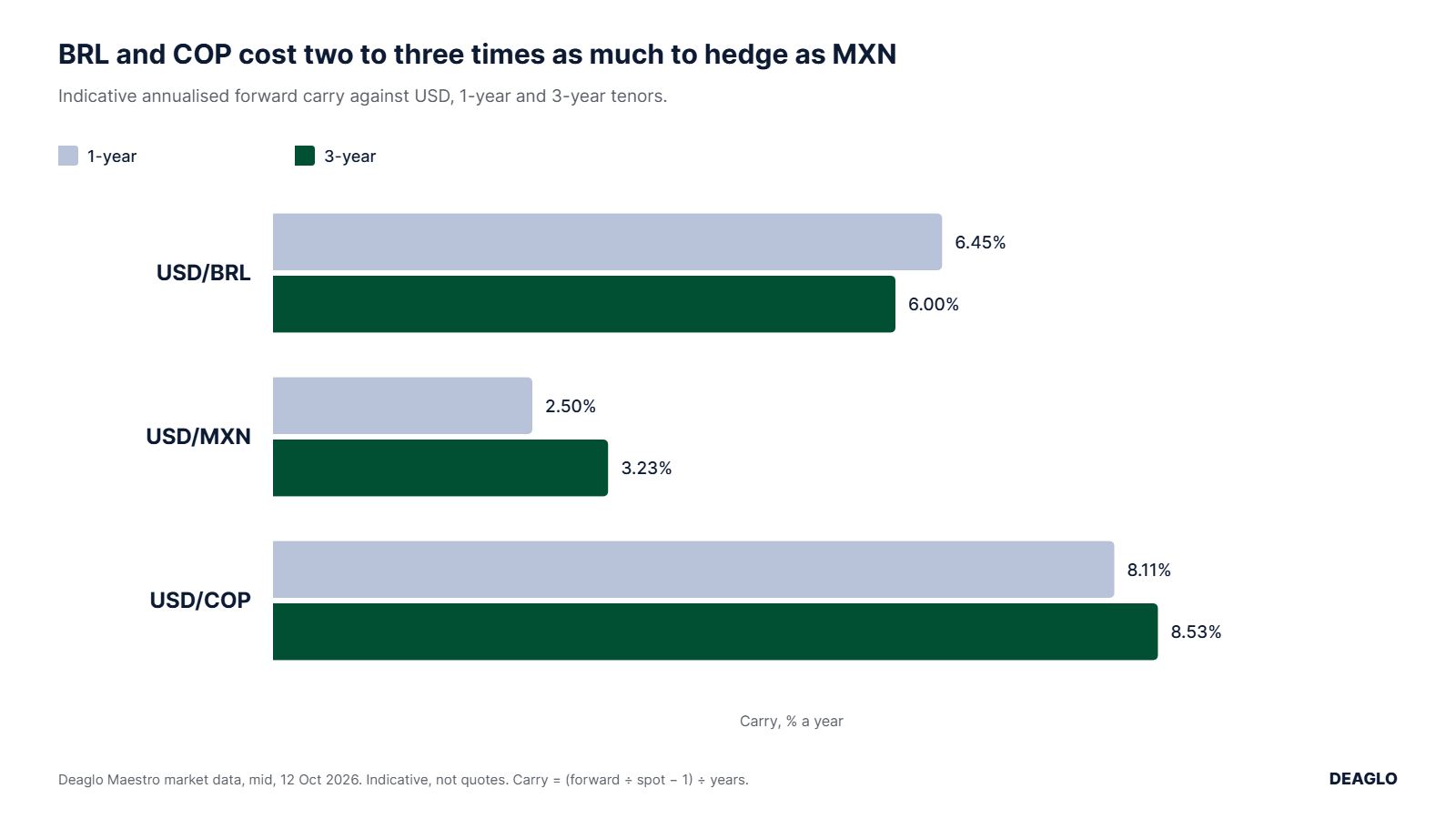
Two points stand out. BRL and COP cost roughly two to three times as much to hedge as MXN. And the curves differ in shape: MXN and COP carry rises with tenor (the MXN 3-year sits about 75 basis points above the 1-year), while BRL's 3-year carry is slightly below its 1-year.
What does a hedged BRL loan actually yield in dollars? A worked example
Illustrative example. Figures are simplified to show the mechanics. They are not a projection, a quote, a market level or the results of any Deaglo client.
- Notional: $25m converted at spot 4.9905 = BRL 124.8m.
- Coupon: 18.0% fixed in BRL, paid annually, standing in for a local benchmark rate plus a private credit spread.
- Amortisation: one third of principal each year, with interest on the outstanding balance.
- Hedge: each BRL payment sold forward into USD at the matching tenor (12, 24 and 36 months, mid).
- 1 — BRL received (m): 64.04; Forward, USD/BRL mid: 5.3122; USD received, hedged ($m): 12.06
- 2 — BRL received (m): 56.56; Forward, USD/BRL mid: 5.5882; USD received, hedged ($m): 10.12
- 3 — BRL received (m): 49.07; Forward, USD/BRL mid: 5.8886; USD received, hedged ($m): 8.33
The BRL yield is 18.0%. The hedged USD IRR on the $25m outlay is about 11.4% at mid; the offer side of the forward costs about 0.06 points more. The gap of roughly 6.6 points is the carry, compounded across the schedule.
The hedge does not remove credit risk. It fixes the USD value of cash flows the borrower has promised, not cash flows the borrower will certainly pay.
How do hedged and unhedged outcomes compare?
A hedge replaces a wide range of USD outcomes with one number. If spot follows the forward curve, the unhedged loan earns the same 11.4% as the hedged one, so the forwards are the break-even path.
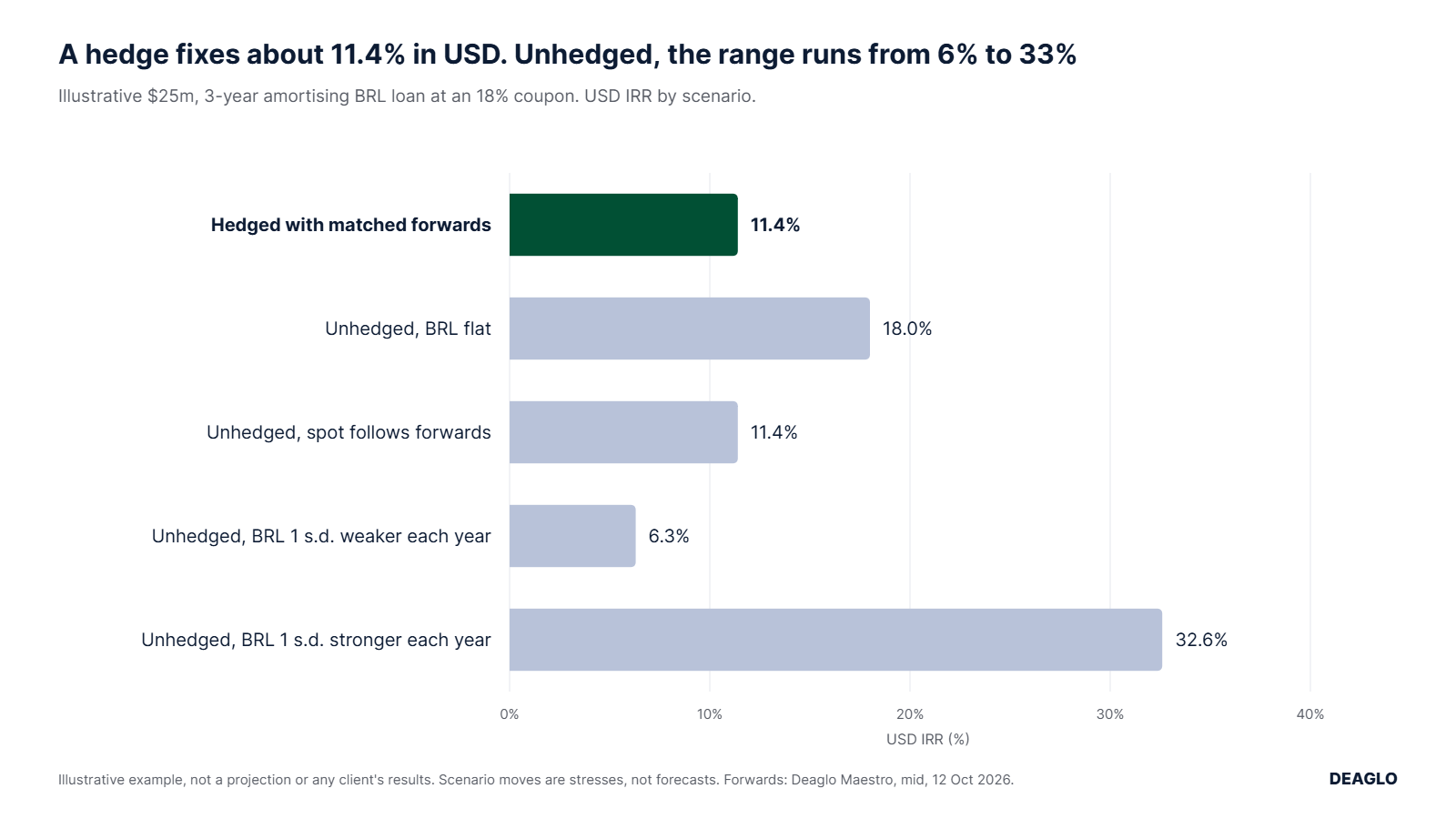
The unhedged lender is exposed to BRL both ways. A one-standard-deviation weakening each year (11.0%, BRL realised volatility) cuts the USD IRR to about 6.3%; the same move in the other direction lifts it to about 32.6%. These are stresses, not forecasts. Past volatility is not necessarily indicative of future volatility.
NDF, cross-currency swap or options: which instrument fits?
For a USD lender to a BRL borrower, the common default is a strip of NDFs matched to each payment date. A cross-currency swap can fit better when the loan is long-dated or floating-rate and a bank will take the tenor. Bought options can fit when the fund cannot post margin and accepts paying a premium.
- Rolled short-dated NDFs — How it works: Hedge 3 to 6 months at a time and roll. Cash-settled in USD against the fixing.; Cash and collateral impact: Settlement cash flow at each roll, which can be large after a move. The roll cost resets with the curve.; Typical use: Uncertain timing, short loans or tight credit lines. Accepts roll and liquidity risk.
- Matched-tenor NDF strip — How it works: One NDF per interest and principal date, sized to the schedule.; Cash and collateral impact: Fixes the full carry up front. Mark-to-market builds over the life, so margin is called under a CSA.; Typical use: Fixed-rate amortising loans with a firm schedule.
- Cross-currency swap — How it works: Exchange USD for local principal, swap coupons (for example SOFR against CDI or TIIE), and re-exchange at maturity.; Cash and collateral impact: Large mark-to-market on the final exchange. Heavy use of credit lines and CSA margin. Basis enters the price.; Typical use: Floating-rate or bullet loans of 3 years or more.
- Options and collars — How it works: Buy a USD call / local-currency put, or fund it by selling an option (a collar).; Cash and collateral impact: A bought option costs a premium up front; the maximum loss is the premium plus costs, and the premium is lost if the option is not used. A collar's sold option carries margin calls and can create large losses.; Typical use: Covering a downside tail where margin capacity is scarce.
Which practical issues decide whether the hedge works?
- Amortisation. Size each forward to the scheduled payment, not the headline notional. A bullet hedge on an amortising loan is over-hedged from the first repayment.
- Prepayment and default. Hedge contracted cash flows, then decide how much of the tail to cover. A common approach is to hedge a set share of scheduled flows below 100% and top up as payments arrive. Unwinding after a prepayment or default crystallises the mark-to-market, which can be a gain or a loss.
- Credit lines, ISDA and CSA. A 3-year strip uses meaningful bank credit line. In the example, a one-year move equal to BRL realised volatility shifts the mark-to-market by roughly $3.4m on $30.5m of hedged USD flows (undiscounted, approximate). Under a CSA that is cash the fund must find.
- Liquidity and margin planning. Model margin calls under stress before signing, and size a liquidity reserve or subscription-line headroom to cover them.
- Onshore and offshore. BRL, COP and often MXN hedges for offshore funds are NDFs, settled in USD against the official fixing. Onshore deliverable markets can price differently; the gap is basis the fund pays or receives.
- Bid-offer at tenor. At 3 years the indicative forward bid-offer was about 0.26% of the rate for BRL, 0.29% for MXN and 0.34% for COP. It is a one-off cost, and it tends to widen in stress.
- Convertibility and transfer. An NDF covers the price, not the ability to move cash. Capital controls or a delayed remittance can leave the fund paying USD on the hedge while local cash is trapped.
What do LPs and investment committees expect to see?
In our view, an investment committee should see hedged and unhedged returns side by side before capital is committed, not after.
- A written FX policy: hedge ratio, permitted instruments, tenor limits and who can trade.
- Returns shown hedged and unhedged, with the carry cost stated in basis points a year.
- Stress tests: margin calls under a 1 to 2 standard deviation move, and the liquidity that covers them.
- A counterparty map: which banks, which ISDA and CSA terms, and credit line usage.
- Treatment of prepayment, default and trapped cash, including unwind cost.
- Ongoing reporting: hedge effectiveness and mark-to-market at each valuation date.
Deaglo models loan cash flows under current market data and compares hedge structures for private credit funds. Learn how Deaglo approaches FX risk management.
About the author
Ashley Groves is CEO and Founder of Deaglo, an FX and interest rate risk advisory firm with offices in New York, São Paulo and Mexico City. She has spent more than 15 years in institutional FX, including a decade at AFEX as Director of Managed FX. Deaglo advises GPs, LPs, private credit funds, portfolio companies and corporates on managing currency and interest rate risk.
Methods. All market figures are indicative mid rates from Deaglo's Maestro market data as of 12 October 2026: USD/BRL spot 4.990, USD/MXN 18.329, USD/COP 3,180.52; forward strips at 12, 24 and 36 months; bid-offer from the same strips. Realised volatility is trailing one-year daily spot, annualised over 251 sessions (BRL 11.0%, MXN 8.0%, COP 14.8%). The worked example's coupon, amortisation and scenarios are illustrative assumptions; USD yields are IRRs on those cash flows. Cross-currency basis and onshore pricing were not modelled. Figures are not quotes.
This article is for general information and education only. It is not investment, legal, tax or accounting advice, and it is not a recommendation or solicitation to enter into any transaction. Trading foreign exchange, forwards, options and other derivatives involves substantial risk of loss and is not suitable for every person. Hedging reduces some risks but has costs, and a hedged position can perform worse than an unhedged one. Opinions are Deaglo's as of the publication date and may change. Prices and market data are indicative as of the time shown and are not quotes.