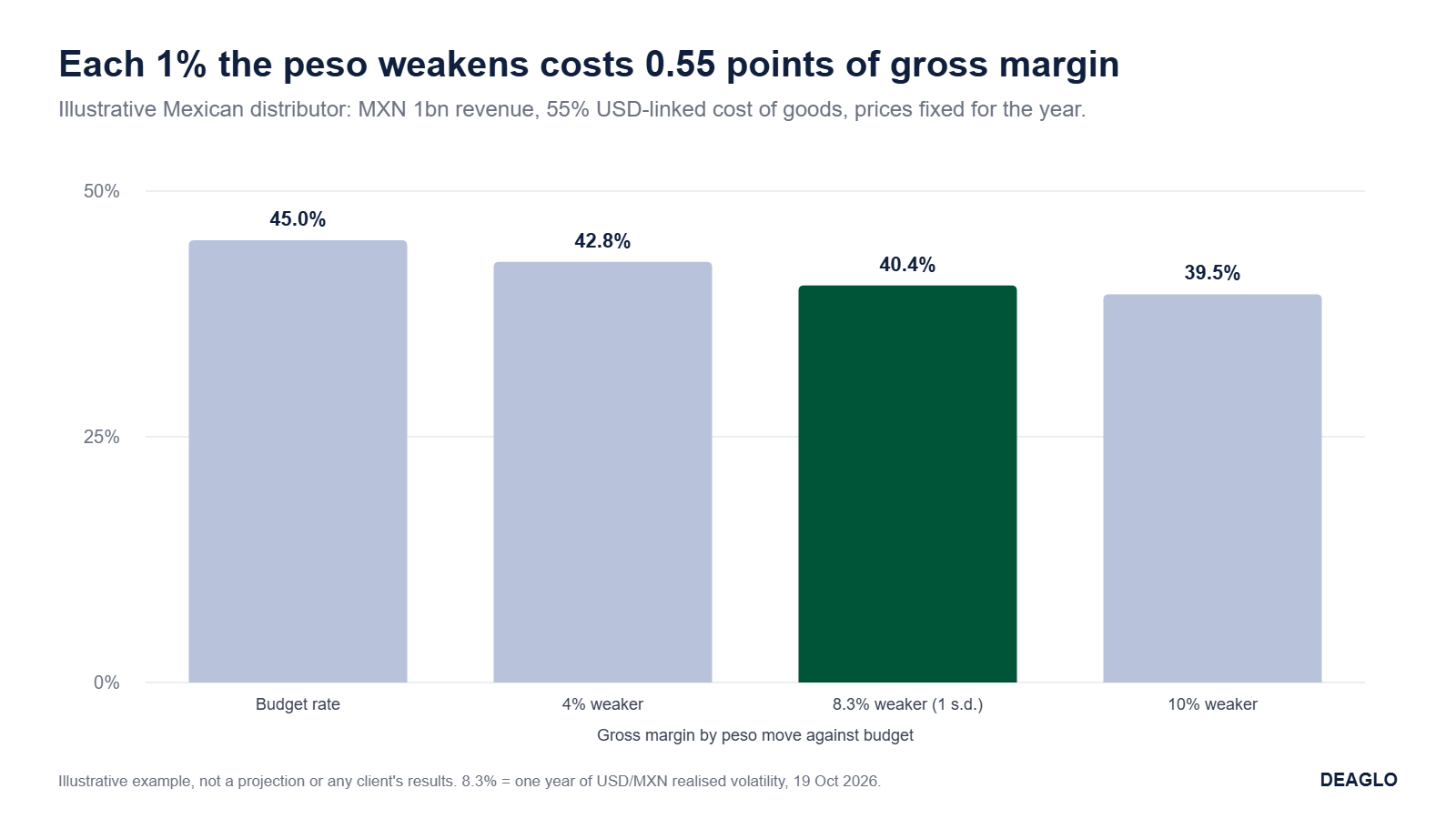
Short answer: a company with USD costs and MXN revenue loses gross margin in proportion to its USD-linked cost share. With 55% USD-linked cost of goods sold, a 10% weaker peso cuts gross margin by 5.5 points.
In our view, the budget rate should be the 12-month forward (USD/MXN 18.93 on 19 October 2026, indicative), not spot at 18.49. Many companies then layer hedges, for example 75%, 50% and 25% across 0 to 3, 3 to 6 and 6 to 12 months, and use options or collars where volumes or pricing power are uncertain.
How does a peso move reach gross margin?
When 55% of revenue is USD-linked cost, each 1% the peso weakens against budget costs 0.55 points of gross margin. Gross profit falls faster, about 1.2% for each 1% move, because the margin base is only 45% of revenue.
Illustrative example. Figures are simplified to show the mechanics. They are not a projection, a quote or the results of any Deaglo client.
Take an illustrative Mexican distributor. Revenue is MXN 1bn, priced in pesos. USD-linked cost of goods is MXN 550m at the budget rate, so budget gross margin is 45%. Prices cannot be reset inside the year.
- Revenue — At budget rate: 1,000.0; Peso 8.3% weaker: 1,000.0
- USD-linked cost of goods — At budget rate: 550.0; Peso 8.3% weaker: 595.6
- Gross profit — At budget rate: 450.0; Peso 8.3% weaker: 404.4
- Gross margin — At budget rate: 45.0%; Peso 8.3% weaker: 40.4%
The 8.3% move is one year of USD/MXN realised volatility (8.28% annualised as of 19 October 2026): a one-standard-deviation year, not a tail event.
Over the last 12 months USD/MXN traded between 16.89 and 18.69, a spread of 10.7% from low to high. From its early-September low the rate rose about 9.5% to 18.49 on 19 October. A budget set at that low would already be about 5.2 points of margin behind. Past results are not necessarily indicative of future results.
Which budget rate should a CFO use: spot, forward or buffered?
The 12-month forward is the rate a company can actually fix for next year. On 19 October 2026 USD/MXN spot was 18.49 and the 12-month forward mid was 18.93 (indicative). The gap is 0.44 pesos, about 2.4% a year of carry.
- 3 months — Forward mid: 18.6086; Points vs spot (MXN): +0.1205
- 6 months — Forward mid: 18.7142; Points vs spot (MXN): +0.2261
- 9 months — Forward mid: 18.8199; Points vs spot (MXN): +0.3319
- 12 months — Forward mid: 18.9318; Points vs spot (MXN): +0.4438
Spot 18.4880 mid, Deaglo Maestro market data, 19 October 2026. Indicative, not quotes.
Three choices make three different promises to the board:
- Spot (18.49). This builds in a miss. In the illustrative P&L, costs hedged at the forward land MXN 13.2m above a spot budget, 1.3 points of margin, before any market move.
- Forward (18.93, or the forward for each quarter). Hedged volumes land on budget. Only the unhedged share and forecast error create variance.
- Buffered (for example 19.72). The forward plus half a year of realised volatility. It gives commercial teams a cushion, but it can hide a real cost increase and encourage under-hedging.
In our view, budgeting at the forward by quarter and reporting variance against it gives the board the clearest picture. A buffered rate is better kept for pricing decisions than used as the hedge benchmark. Forward points move with the gap between Banxico and Federal Reserve rates, so they need refreshing each budget cycle.
How does a layered hedging programme work?
A layered programme hedges a declining share of forecast USD costs by tenor, then tops up each quarter. A common shape is 75% of months 0 to 3, 50% of months 3 to 6 and 25% of months 6 to 12.
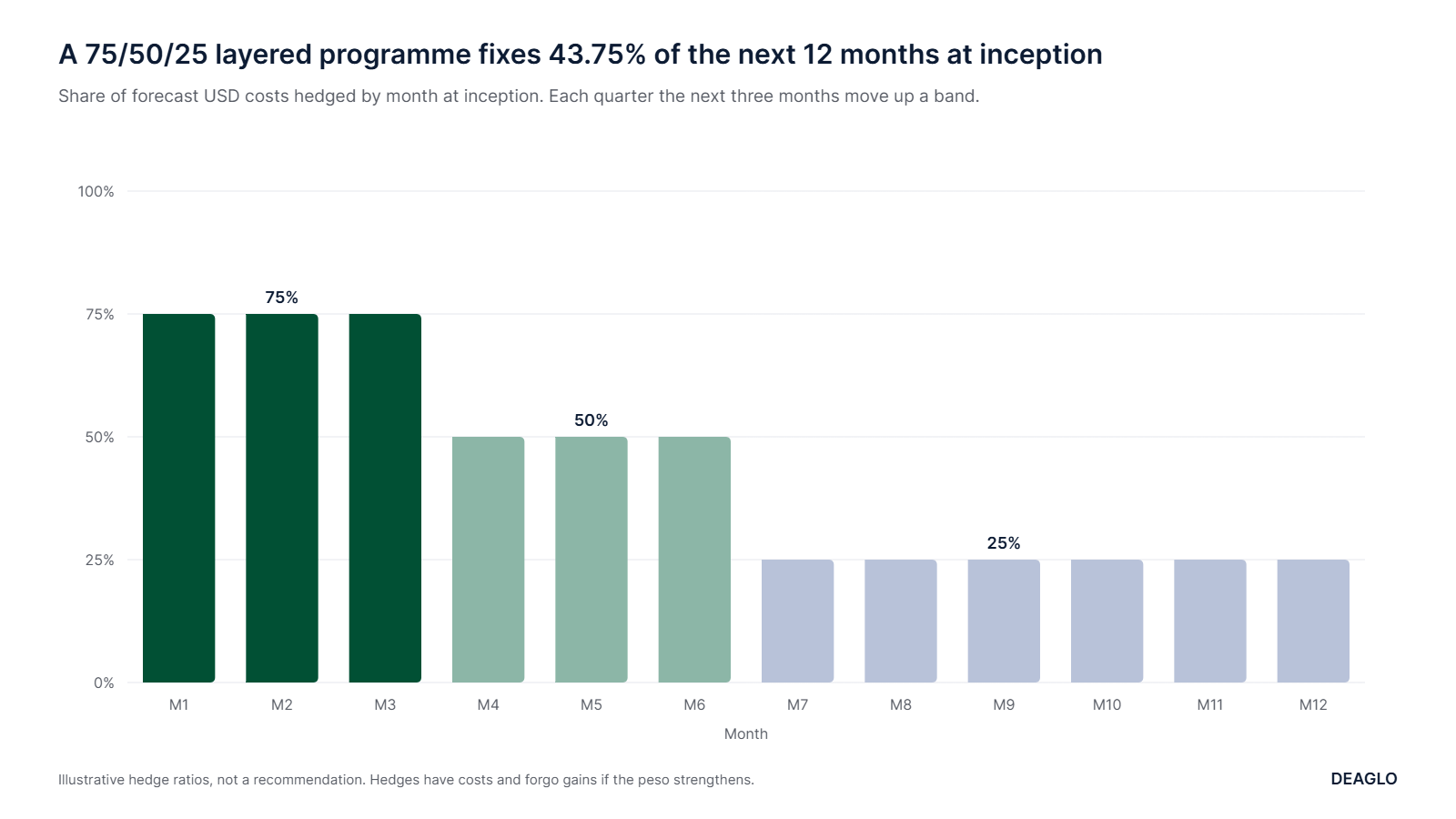
At inception that fixes 43.75% of the next 12 months of USD costs. Each quarter the next three months move up a band, from 25% to 50% and from 50% to 75%, so every month is 75% hedged by the time it arrives, at a blend of rates struck over three quarters. No single dealing date sets the year.
A hedge programme does not remove a currency move; it delays its effect. In the illustrative case, the layers at inception absorb about 44% of the first-year cost of a sudden peso sell-off and give the business two to three quarters to reprice. The hedges also forgo much of the benefit if the peso strengthens, and they have costs. Where a business can reprice faster, lower ratios can be defensible; where it cannot, companies often raise the far bands or add options.
Forwards, options or collars: which fits?
Forwards tend to fit when volumes are firm and costs cannot be passed through. Bought options tend to fit when volumes are uncertain, or when a stronger peso would let competitors cut prices. Collars sit between the two, for a smaller premium.
Indicative option pricing for a 12-month USD call / MXN put, USD 1m notional, expiry 18 October 2027, priced 19 October 2026 (mid, not quotes):
- Forward at 18.93 — Upfront cost: None; Worst-case rate: 18.93; Participation if the peso strengthens: None; Cash, credit and risk: Uses a credit line; mark-to-market can trigger collateral calls; Typical use: Firm volumes, thin margins, no pricing power
- Bought USD call, strike 18.93 (near the forward) — Upfront cost: USD 43,702 (4.4%); Worst-case rate: 19.74 including premium; Participation if the peso strengthens: Full below 18.93; Cash, credit and risk: Premium paid up front and lost if unused; maximum loss is the premium plus costs; Typical use: Uncertain volumes, tenders, M&A-linked flows
- Bought USD call, strike 19.50 — Upfront cost: USD 33,609 (3.4%); Worst-case rate: 20.12 including premium; Participation if the peso strengthens: Full below 19.50; Cash, credit and risk: Premium paid up front and lost if unused; Typical use: Tail cover on top of a forward layer
- Collar: buy 19.50 call, sell 18.50 put — Upfront cost: USD 2,071 net (0.2%); Worst-case rate: 19.54 including premium; Participation if the peso strengthens: Down to about 18.54; Cash, credit and risk: The sold put uses a credit line, can bring margin calls and gives up gains below 18.50; Typical use: Budget cover with some participation and little cash
Implied volatility was about 11.5% near the forward strike, against 8.3% realised over the past year, so options were pricing a wider range than the last 12 months delivered.
A common mix is forwards on the firm near-term layer and options or collars on the less certain far layers, where forecast error is largest and an over-hedged forward can do the most damage.
What governance does an FX hedging programme need?
A board-approved FX policy sets hedge ratio bands by tenor, approved instruments, counterparty limits, the budget-rate method and who can deal. Lender documents are worth checking early: credit agreements often require hedging, cap derivative exposure or restrict sold options, and collateral calls can strain a revolver.
Under IFRS 9 or ASC 815, forecast USD purchases can qualify for cash flow hedge accounting, which keeps mark-to-market in OCI until inventory reaches cost of goods. That needs designation and documentation at inception, and an explicit accounting choice for an option's time value or a forward's points.
Deaglo models gross margin exposure under current market data and simulated currency paths, so boards can see the trade-offs before they approve a policy. Learn how Deaglo approaches FX risk management.
About the author
Ashley Groves is CEO and Founder of Deaglo, an FX and interest rate risk advisory firm with offices in New York, São Paulo and Mexico City. He has spent more than 15 years in institutional FX, including a decade at AFEX as Director of Managed FX. Deaglo advises GPs, LPs, private credit funds, portfolio companies and corporates on managing currency and interest rate risk.
Methods. Deaglo Maestro market data, indicative mid rates, not quotes. USD/MXN spot 18.4880 and forward strip (3, 6, 9 and 12 months) as of 19 October 2026. Realised volatility 8.28%, trailing year of daily spot, annualised over 251 sessions. 12-month range from daily spot, 19 October 2025 to 16 October 2026. Option premiums from live option pricing, mid, European, USD 1m notional, expiry 18 October 2027; the option model's 12-month forward (18.93) matches the strip. The P&L, hedge ratios, buffered rate and scenario margins are illustrative arithmetic on those figures.
This article is for general information and education only. It is not investment, legal, tax or accounting advice, and it is not a recommendation or solicitation to enter into any transaction. Trading foreign exchange, forwards, options and other derivatives involves substantial risk of loss and is not suitable for every person. Hedging reduces some risks but has costs, and a hedged position can perform worse than an unhedged one. Opinions are Deaglo's as of the publication date and may change. Prices and market data are indicative as of the time shown and are not quotes.