No Patricular Category
Hedging & Risk
Protege el margen de tu empresa frente a la volatilidad del USD/MXN
Ashley Groves
October 8, 2026
7 min read
Filters
.png)
Hedging & Risk
No Patricular Category
Fixed vs Floating Rates: Key Differences & Risk Management Strategies
Fixed vs floating rates play a critical role in interest rate risk management, directly influencing cash flows, borrowing costs, and investment returns for corporates and investment funds. Fixed rates provide stability and predictability, while floating rates introduce variability based on market benchmarks such as SOFR. This article explains the key differences between fixed and floating rate exposure, highlights real-world examples of how interest rate movements impact profitability and IRR, and outlines how organizations measure and manage this risk. By using strategies such as interest rate swaps, scenario analysis, and technology-driven insights, businesses can balance cost certainty with flexibility and make more informed, data-driven financing and investment decisions in changing rate environments.
3 Mins
6.4.2026
.png)
Hedging & Risk
No Patricular Category
FX Cashflow Risk: Managing Currency Impact on Cash Flows for Corporates and Funds
Transactional exposure is one of the most immediate and measurable forms of foreign exchange (FX) risk, arising from contractual cash flows denominated in foreign currencies. It directly impacts cash flow, profitability, and investment returns for both corporates and investment funds. This article explains how transactional exposure occurs, highlights real-world examples across corporates and funds, and outlines common sources such as export revenues, import costs, capital flows, and foreign currency debt. It also explores how exchange rate fluctuations can compress margins, reduce returns, and increase earnings volatility. To manage this risk, organizations adopt structured approaches including forward contracts, FX options, and natural hedging strategies. With the support of modern technology and real-time data, businesses can improve visibility, enhance decision-making, and stabilize financial outcomes in an increasingly volatile global market.
3 mins
6.4.2026
.png)
Hedging & Risk
No Patricular Category
Economic FX Exposure Explained: Impact, Examples & Management Strategies
Economic FX exposure refers to the long-term impact of currency movements on a company’s or investment’s cash flows, competitiveness, and overall valuation. Unlike transactional or translational exposure, it is strategic and forward-looking, affecting revenue growth, cost structures, and investment returns across global markets. For corporates, currency fluctuations can compress margins and reduce market competitiveness, while for investment funds, they can erode returns and distort IRR despite strong underlying asset performance. Managing economic FX exposure requires a structured approach that combines scenario analysis, operational alignment, financial hedging, and real-time analytics. By leveraging technology and data-driven decision-making, organizations can better anticipate currency risk, stabilize financial performance, and optimize outcomes in volatile FX environments.
4 mins
6.4.2026
.png)
Hedging & Risk
No Patricular Category
Translational Exposure: Understanding FX Risk in Financial Reporting
Translational exposure is a key component of FX risk management that affects how multinational corporates and investment funds report financial performance across currencies. It arises when foreign subsidiaries’ financial statements are converted into a reporting currency, creating fluctuations in reported earnings, balance sheet valuations, and financial metrics. While translational exposure does not impact actual cash flows, it can significantly influence investor perception, financial reporting consistency, and overall valuation. By adopting structured approaches—such as balance sheet hedging, currency matching, and centralized exposure monitoring organizations can reduce reporting volatility and improve financial transparency across global operations.
3 mins
4.4.2026
.png)
Hedging & Risk
No Patricular Category
Transactional Exposure: Understanding FX Exposure in Cash Flows
Transactional exposure is a key type of foreign exchange (FX) risk that arises from contractual cash flows denominated in foreign currencies. It directly impacts cash flow, profitability, and financial performance, making it one of the most immediate and measurable forms of FX exposure.
3 mins
3.4.2026
.png)
Hedging & Risk
No Patricular Category
Challenges in Managing FX Exposure and Currency Risk
Managing FX exposure is complex due to fragmented data, reliance on spreadsheets, and lack of real-time visibility. These challenges lead to delayed decision-making, increased operational risk, and inefficient FX risk management across corporates and investment funds.
3 mins
2.4.2026
.png)
Hedging & Risk
No Patricular Category
Why Your FX Process Is Costing More Than the Hedge — A Corporate Treasury Framework
FX risk is often underestimated until it directly impacts earnings, cash flow, and financial performance. For corporates operating across multiple currencies, fragmented processes and limited visibility can create hidden costs that go far beyond hedge pricing. This guide explores how leading treasury teams move from reactive FX management to a structured, data-driven framework. By centralizing exposure, applying scenario-based decision-making, and embedding governance into workflows, organizations can reduce earnings volatility, improve financial visibility, and make more consistent, defensible decisions.
3 mins
1.4.2026
.png)
Hedging & Risk
No Patricular Category
Is FX Risk Quietly Eroding Your Margins? A Corporate Treasury Framework
Is FX risk quietly eroding your margins? For companies operating across borders, foreign exchange exposure often goes unnoticed until it impacts earnings, financial reporting, and decision-making. This article explores how leading corporate treasury teams move beyond fragmented processes by adopting structured FX risk management frameworks. By focusing on centralized visibility, scenario-based decision-making, and governance, organizations can reduce earnings volatility, improve financial visibility, and make faster, data-driven decisions.
3 mins
1.4.2026
Deaglo Platform
No Patricular Category
FX Intelligence for Corporates, Cross-Border Transactions, and Global Investment Funds
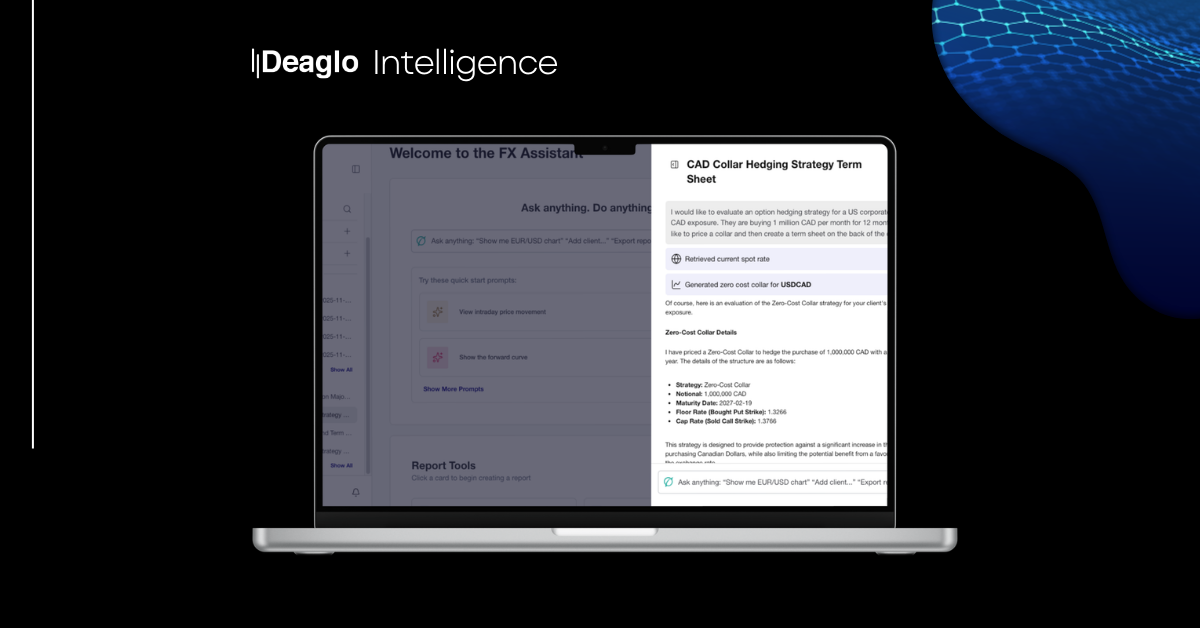
Deaglo Intelligence is an FX intelligence platform designed to help corporates, investment funds, and financial institutions manage cross-border currency exposure. The platform centralizes FX exposure data, enables scenario analysis, and evaluates hedging strategies to help organizations quantify how currency movements affect cash flows, investment returns, and financial performance. By replacing fragmented spreadsheets with a structured analytics environment, Deaglo Intelligence allows institutions to monitor FX risk, simulate market conditions, and make more informed and disciplined financial decisions.
3 -4 mins
9.3.2026